Hiring changed overnight.
What took weeks now happens in days. Sometimes hours.
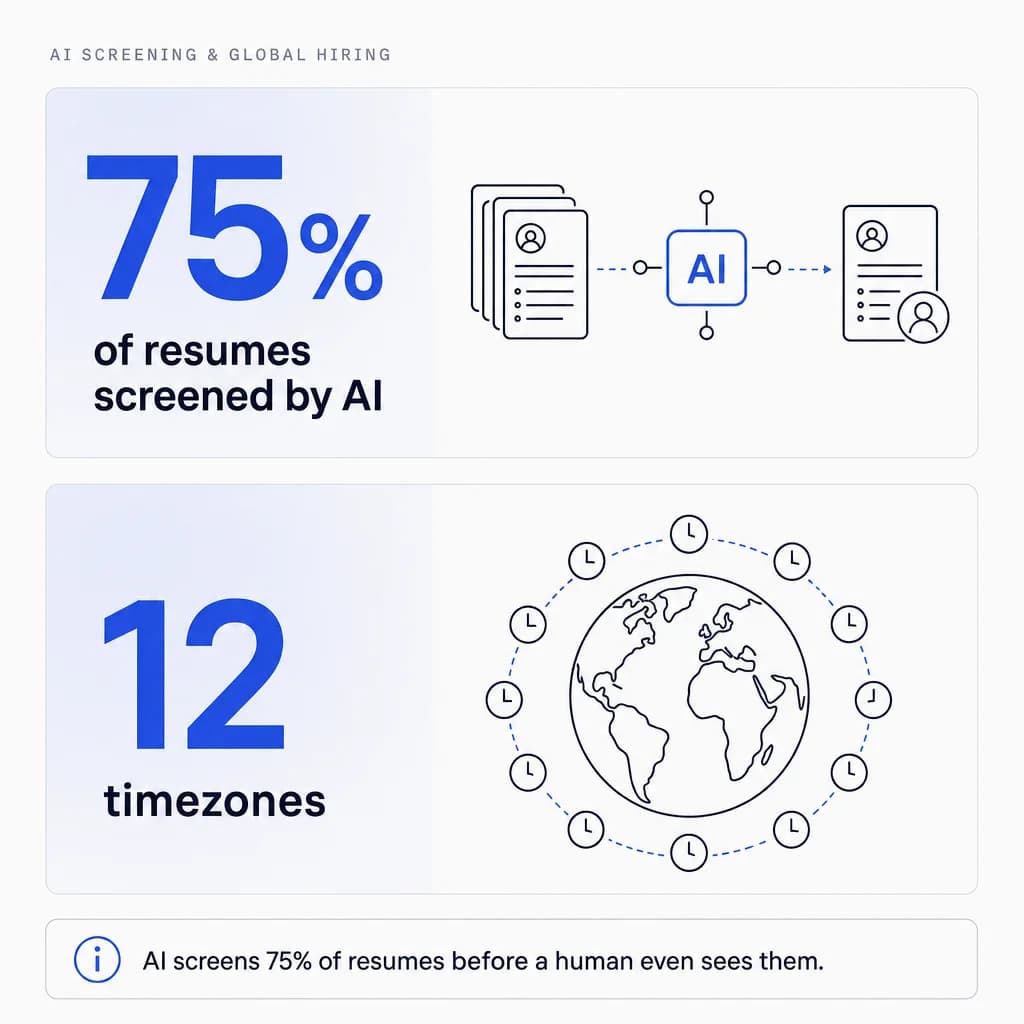
AI screens 75% of resumes before a human even sees them. Companies hire across 12 timezones. Compliance rules multiply faster than anyone can track.
And your HR virtual assistant? They’re right in the middle of it all.
These remote workers handle applicant tracking systems, virtual onboarding, and cross-timezone coordination at $7-15/hour. That’s 80% less than local hires, according to VA Masters data.
But here’s the thing.
Not every HR assistant can keep up with how fast hiring moves now. The skills that worked in 2020 don’t cut it in 2026.
So what does your HR assistant actually need to know right now?
The AI Tools Everyone’s Using (And Your HR Assistant Should Too)
AI screens resumes. AI schedules interviews. AI generates job descriptions.
But AI also hallucinates. It misses context. It can’t tell when a candidate is perfect on paper but wrong for your culture.
That’s where your HR assistant comes in.
Why ATS proficiency isn’t optional anymore
Indeed shows 186+ remote entry-level HR assistant jobs requiring ATS experience: Workable, BambooHR, Greenhouse. These aren’t nice-to-haves anymore.
According to AIHR Institute, office assistants now spend significant time reviewing AI-generated documents. They verify outputs. They flag biases. They catch when ChatGPT invents a certification that doesn’t exist.
One employer put it this way: their Filipino remote worker caught AI hallucinations in candidate summaries that would’ve led to bad hires.
The BPO advantage in AI tool mastery
Filipino remote workers have an edge here. BPO training means they’ve used these systems for years. They don’t need three months to figure out how BambooHR works. They already know.
They’ve screened thousands of resumes. They’ve navigated multiple ATS platforms. They’ve learned to spot when AI gets it wrong.
Why Digital Fluency Means More Than Knowing Microsoft Office
Remote onboarding happens over Zoom. Data lives in Rippling or Gusto. Communication runs through Slack.
Your HR assistant juggles 50+ applications daily.

The modern HR tech stack your assistant needs to master
Comfort with HR software is essential now. O*NET data shows 1-2 years of training is standard for these roles.
But it’s not just HRIS platforms.
Online gigs list Canva for recruitment graphics, Hootsuite for employer brand posts, Loom for onboarding videos, and Google Workspace for everything else.
The best remote workers don’t just know these tools. They know which tool solves which problem, fast.
Why tool-switching speed matters in 2026
Your company switches from BambooHR to Rippling. Your team adopts a new scheduling tool. Your ATS updates its interface overnight.
Your HR assistant adapts without missing a beat. No three-week learning curves. No productivity dips.
That’s the digital fluency that separates good hires from great ones.
Organization Isn’t Optional When You’re Managing Hundreds of Applicants
You post a job. 500 applications flood in within 48 hours.
Half are unqualified. A quarter are spam. The rest need screening, scheduling, and follow-up.
One mistake, one missed email, one lost resume, and you lose a great candidate to your competitor.
The detail-orientation that prevents costly hiring mistakes
Coursera research emphasizes organizational skills under pressure as critical for entry-level HR roles. Indeed’s top job postings require “detail-oriented for remote priorities.”
Filipino remote workers excel here because BPO environments demand it. Sloppy calendars don’t survive in a call center managing 1,000 daily interactions.
Error-free payroll records. Organized interview schedules across timezones. Clean data entry in your HRIS.
That’s the baseline now.
How BPO training builds organizational muscle memory
BPO workers track multiple clients, hundreds of tasks, and shifting priorities simultaneously. They build systems because chaos isn’t an option.
That training transfers directly to HR work: multiple job requisitions, different hiring stages, competing deadlines.
They’ve already learned to manage it all without dropping a single ball.
Communication Across Cultures and Timezones
The Philippines is 13-16 hours ahead of the US.
That timezone difference? It’s actually an advantage. Your HR assistant works while you sleep. Candidates get responses overnight. Interviews get scheduled for your morning, their evening.
But timezone coordination is just part of it.
The written and verbal communication standards that matter
HR University lists strong communication for employee requests as essential. Clear emails to candidates. Professional phone screens. Written updates that don’t need three follow-up questions.
Filipino remote workers handle this naturally. English is a primary language. BPO training includes accent neutralization and professional communication standards.
One UK employer said their remote worker’s English surpassed local candidates and handled Australian interviews flawlessly.
Navigating cross-cultural communication styles
Filipino workers tend toward politeness and indirect communication. If you’re in the US, UK, or Australia, you might need to teach direct feedback styles during onboarding.
But that’s a one-week fix, not a dealbreaker.
Once they understand your communication preferences, they adapt seamlessly. They learn your company’s tone. They mirror your directness level. They adjust to your feedback culture.
Why timezone overlap creates 24-hour productivity
Your US-based team logs off at 5 PM. Your Filipino HR assistant logs on at 6 PM your time.
Candidate emails get answered. Interview requests get processed. Background checks get tracked.
By the time you start your workday, half your HR tasks are already done.
Time Management When Hiring Cycles Move at 48-Hour Speeds
Fast hiring isn’t coming. It’s here.
You need someone screened by tomorrow. An offer letter drafted by end of day. Onboarding materials ready for a Monday start.
Your HR assistant manages multiple requisitions, each moving at different speeds. One role needs 10 candidates screened. Another needs background checks tracked. A third needs onboarding documents prepared.
The multitasking skills that keep hiring moving
Kennesaw State University research confirms HRIS proficiency is vital for 2026 roles specifically because it centralizes these moving pieces.
They don’t just manage tasks. They prioritize. They know what’s urgent versus what’s important. They know when to escalate and when to solve it themselves.
Adaptability when processes change overnight
Compliance rules change. A new state passes pay transparency laws. GDPR updates. Your ATS switches platforms.
Your HR assistant pivots without missing a beat.
They don’t need hand-holding through every change. They research the new requirement. They update the process. They document it for next time.
That adaptability keeps your hiring machine running even when everything around it shifts.
The New Skills Nobody Talked About Two Years Ago
Privacy and compliance used to be the legal team’s problem.
Not anymore.
Privacy and data protection in global hiring
GDPR applies to EU candidates. CCPA covers California. Every state has different background check rules. Hiring globally means navigating visa requirements, data protection, and employment law across borders.
AIHR Institute now emphasizes privacy-aware data handling for HR assistants. Filipino remote workers often get this training through BPO compliance programs. US clients specifically praise this.
Your HR assistant needs to know which data they can collect, how to store it, and when to delete it. They need to recognize when a process violates privacy law before it becomes a legal problem.
DEI and inclusive communication practices
Your HR assistant screens for bias-free language in job posts. They ensure interview panels are diverse. They track demographic data without violating privacy rules.
Coursera reports growth in HR entry roles that specifically emphasize these skills.
They catch when a job description accidentally excludes qualified candidates. They notice when your interview process creates barriers for certain groups. They help build inclusive hiring without being asked.
Problem-solving when technology fails
“AI suggests, human decides” is the new workflow, according to AIHR. When your ATS glitches during a critical interview, your HR assistant troubleshoots it. When a candidate’s timezone conversion is wrong, they fix it before anyone notices.
They don’t panic when Zoom crashes five minutes before an interview. They have backup plans. They solve problems in real-time.
Basic analytics and metrics tracking
Track time-to-hire in Google Sheets. Monitor source quality. Report on diversity metrics.
Kennesaw research shows HRIS platforms centralize this data, but someone needs to pull the reports and spot the trends.
Your HR assistant notices when one job board consistently delivers better candidates. They see when time-to-hire spikes and investigate why. They turn raw data into actionable insights.
Where to Actually Find Remote Workers With These Skills
You need someone who can do all this. Where do you look?
The platforms that connect you with pre-vetted talent
HireTalent.ph specializes in connecting employers with pre-vetted Filipino remote workers who have the exact HR experience you need.
The platform lets you filter by specific skills like ATS experience or HRIS proficiency, so you’re not wading through hundreds of unqualified applications.
Other options exist too. VA Masters shows $7-15/hour rates with 1,000+ placements. Upwork lets you filter for “HR Assistant + Philippines.” VirtualStaff.ph offers direct integration options.
What your job post should actually say
Here’s what a job post should look like:
Remote HR Assistant
Experience with AI/ATS tools (BambooHR, LinkedIn Recruiter, or similar)
Handle onboarding, candidate communication, and data entry
$8-12/hour, 40 hours/week, must overlap with US/AU/UK timezone
Paid 2-week trial period
Be specific about tools. Be clear about timezone requirements. Include the trial period upfront.
The Bottom Line
Hiring moves fast now. Faster than it did last year. Faster than it will next year.
Your HR assistant needs AI tool proficiency, digital fluency, organization, communication skills, time management, and adaptability. Add privacy knowledge, DEI awareness, problem-solving, and basic analytics.
Filipino remote workers bring these skills from BPO training, English fluency, and timezone advantages. At $7-15/hour, they cost 80% less than local hires.
The Philippines BPO industry grew 10% year-over-year to $30 billion in 2026, according to IBPAP. About 70% of those workers handle HR tasks, per VirtualStaff.ph data.
They’re trained. They’re available. They’re affordable.
Start with a paid trial. Two weeks tells you everything you need to know.
Because hiring isn’t slowing down. And neither should your HR support.