Let me tell you about Zac Alviz.
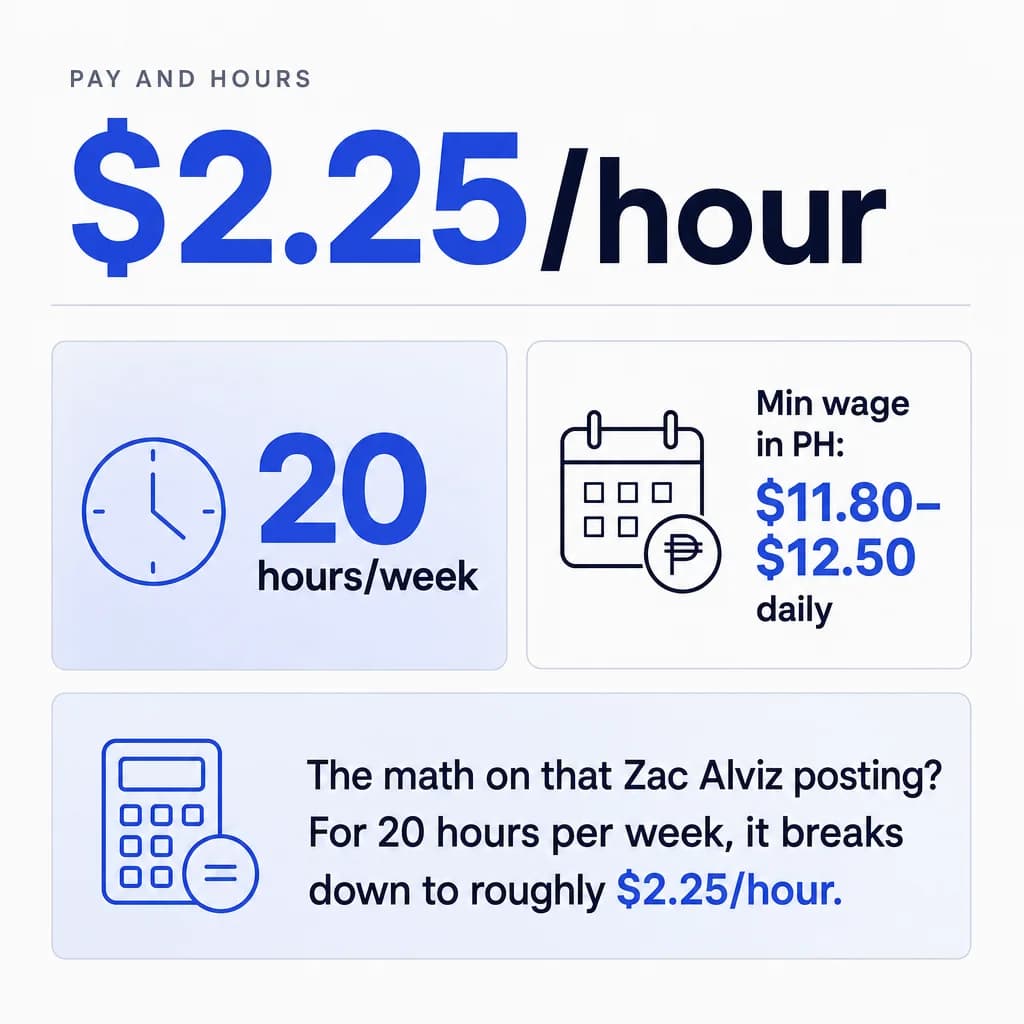
He’s a Filipino entrepreneur who posted a job offering about $180–190 USD per month for a part-time remote worker: twenty hours a week for basic tasks.
The Filipino remote worker community tore him apart.
Within hours, his post was flooded with comments calling it “lowballing.” He eventually took it down and had to issue clarifications.
Here’s the thing: Zac isn’t a villain. And those $200/month job posts? They’re everywhere.
I run HireTalent.ph, and I see these listings constantly. Business owners post them. Remote workers sometimes take them. And almost every single time, it ends badly for both sides.
Yes, People Actually Work for $200/Month
Before we go further, let’s be clear about something.
Yes, you can find Filipino remote workers willing to work for $200/month. They exist. They’ll apply to your job posting.
But here’s what most hiring managers don’t understand: just because someone applies doesn’t mean it’s going to work out.
The Math Doesn’t Add Up
The math on that Zac Alviz posting? For 20 hours per week, it breaks down to roughly $2.25/hour.
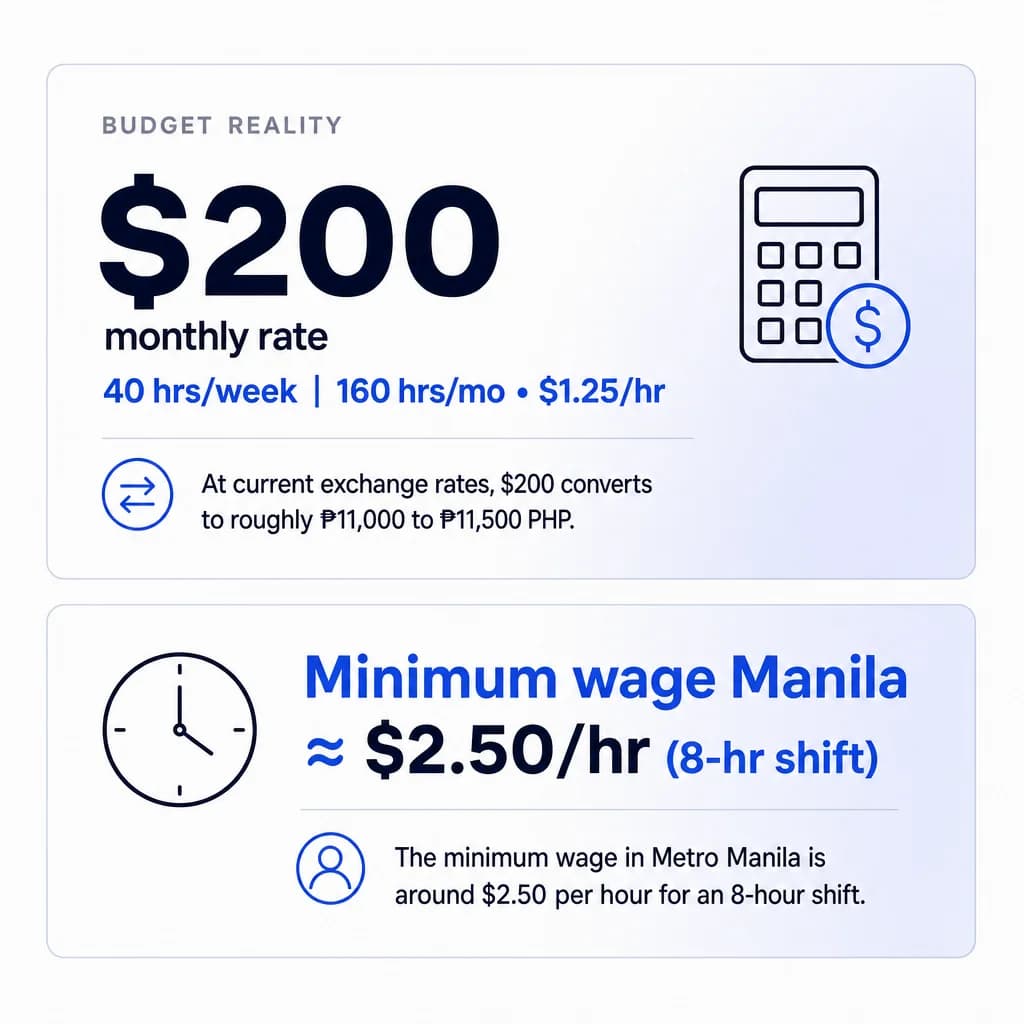
The daily minimum wage in the Philippines ranges from $11.80 to $12.50. Do the math on a standard 8-hour workday and you’ll see the problem immediately.
You’re offering less than minimum wage.
Who Actually Takes These Jobs?
When you post a $200/month position, you’re not getting experienced professionals. You’re getting one of three types of people:
Complete Beginners
People who have never worked remotely before. They don’t know what fair rates look like. They just see “online job” and think any money is good money.
Desperate Workers
People in tough situations who need anything right now. They’ll take your job while actively looking for something better.
Multi-Client Jugglers
They know $200 isn’t enough to live on. So they’re taking your job plus three others. Guess how much focus your tasks get?
Notice who’s missing from that list? Skilled, experienced remote workers who will stick around.
The Real Cost of Cheap Labor
Here’s what actually happens when you hire at $200/month.
Month One: The Honeymoon Phase
Your new hire is learning your systems. You’re spending hours training them. They seem eager enough.
Month Two: Cracks Start Showing
Work quality is inconsistent. They’re slow. You’re spending more time managing them than you’d spend just doing the work yourself.
Month Three: The Disappearing Act
They ghost you. Or they give two days’ notice. Or they’re suddenly “sick” for a week and never come back.
Now you’re back to square one.
The Hidden Financial Damage
You’ve lost three months. You’ve lost all that training time. You’ve lost the work they were supposed to do. And you’re about to spend another month finding and training someone new.
Let’s do the actual math on this:
Training time: 20 hours at your hourly rate (let’s say $50/hour conservatively) = $1,000
Lost productivity while they ramp up: easily another $500
Recruiting time for the replacement: $300
You just spent $1,800 to save $200/month on salary. And you still don’t have a functioning team member.
What The Backlash Actually Tells Us
When Zac’s post got hammered, it wasn’t just people being mean.
The Filipino remote worker community was sending a message: professional work deserves professional pay.
The Market Has Standards
The Philippines has a massive remote work industry. Millions of people work for international clients. There are standards. There are expectations.
When you post a $200/month job, you’re not just offering low pay. You’re signaling that you don’t understand the market.
And the good candidates? They scroll right past.
The Cost of Living Reality Check
“But $200 goes further in the Philippines!”
I hear this constantly. And yes, the cost of living is lower than in the US or Europe.
But let’s talk about what $200 actually covers in the Philippines.
Basic Monthly Expenses for One Person
Decent one-bedroom apartment in a safe area of Manila: $180–270
Utilities: $36–54
Food: $108–144
Internet (essential for remote work): $27–45
Transportation: $36–54
Total minimum: $387

Your $200 doesn’t even cover basic survival. And we haven’t included healthcare, emergencies, or literally anything else.
What Actually Works
Here’s what I’ve seen work consistently over years of watching thousands of hires.
Entry-Level Roles: $600–800/Month
Customer support, data entry, basic admin work. Simple tasks that don’t require specialized skills.
Skilled Work: $800–1,200/Month
Social media management, bookkeeping, executive assistance. Roles requiring experience and judgment.
Specialized Skills: $1,200–2,000+/Month
Developers, designers, senior project managers. Expertise that directly impacts your bottom line.
What Changes at Fair Rates
At these rates, something changes:
You get applicants with experience.
They stay longer than three months.
They actually care about doing good work because the job is worth keeping.
One hiring manager I know tried the $250/month route three times. Each person lasted less than two months. She finally posted at $750/month.
Her hire has been with her for two years now, handles everything, and rarely needs management.
She spent $500 more per month. She saved hundreds of hours of her own time.
The Hidden Costs Nobody Talks About
Low pay creates a cycle that costs you more than money.
The Stress Factor
When someone’s working for $200/month, they’re stressed. They’re worried about money constantly. They’re probably working multiple jobs.
Stressed, distracted workers make mistakes.
Mistakes Cost Real Money
Those mistakes cost you. Wrong data entered. Missed deadlines. Upset customers. Opportunities lost.
I watched a business owner hire a $200/month remote worker to manage his calendar and emails. The worker double-booked him for a client meeting. He lost a $10,000 contract.
Saved $300/month on salary. Lost $10,000 in revenue.
Why Some People Still Do It
So why do smart business owners keep trying to hire at $200/month?
Usually it’s one of three reasons.
They’re Bootstrapping
They literally don’t have more budget. I get it. But here’s the truth: if you can’t afford to pay someone properly, you’re not ready to hire yet.
They Don’t Know Better
They saw a blog post from 2015 talking about “$300 VAs” and thought that’s still the market rate.
They’re Testing the Waters
They want to try remote hiring without committing much money.
That last one makes sense emotionally. But it’s backwards.
You don’t test a new strategy by intentionally doing it wrong. You’re just guaranteeing failure.
What Fair Pay Actually Gets You
When you pay fairly, everything changes.
Better Applicant Pool
Your job post gets better applicants. People with actual experience. People who’ve worked with international clients before.
Longer Tenure
Your hire stays longer. The average tenure at fair rates is 2–3 years. At $200/month? You’re lucky to get 2–3 months.
Less Management Overhead
You spend less time managing. Better workers need less hand-holding. They solve problems instead of creating them.
Actual Business Growth
Your business actually grows. Because you’re not constantly stuck in the hiring-training-replacing cycle.
HireTalent.ph has built-in salary benchmarking tools that show you what real market rates look like for different roles. It takes about 30 seconds to see what you should actually be paying.
The $200 Job That Makes Sense
Is there ever a time when $200/month works?
Maybe. If you’re hiring a college student for 5–10 hours a week of genuinely simple work: data entry, basic research, tasks that require zero decision-making.
Even then, you should probably pay more.
But full-time work? Anything requiring skill or judgment? $200/month is setting yourself up to fail.
What To Do Instead
If you’re reading this and thinking, “but I really can’t afford more than $200/month,” here’s what I’d do.
Hire for Fewer Hours at a Higher Rate
10 hours a week at $400/month ($10/hour) will get you better work than 40 hours at $200/month ($1.25/hour).
You’ll get someone competent who treats your business with respect. They’ll get things done in those 10 hours that your $200 hire wouldn’t finish in 40.
Save Up and Wait
Or save up for another month or two until you can afford proper rates.
Your business will be better off waiting than hiring wrong.
The Bottom Line
Yes, $200/month Filipino remote worker salaries are real.
Yes, people will take those jobs.
And yes, it almost always backfires.
You’ll spend more money fixing mistakes, replacing workers, and managing problems than you’d ever save on the low salary.
The Filipino remote work market is professional. Treat it that way.
Pay fair rates. Get quality workers. Build a team that actually helps your business grow.
Or keep trying to save $300/month while losing thousands in productivity and opportunity costs.
I’ve seen both paths play out hundreds of times. One works. One doesn’t.
Your choice.