
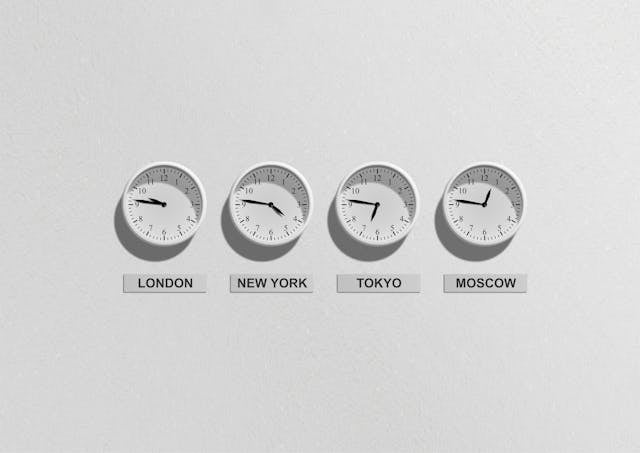
You moved your business to Puerto Rico for the tax benefits.
Or maybe you’re running operations from Atlantic Canada.
Either way, you’re on Atlantic Standard Time now, and you need to figure out how to work with remote workers in the Philippines.
Here’s the good news: the math is dead simple.
Atlantic Standard Time is exactly 12 hours behind Philippine Time. All year. No exceptions.
PHT = AST + 12 hours.
That’s it. That’s the formula.
Need Workers Who Can Match Your Atlantic Hours?
Post your job on HireTalent.ph and Find pre-vetted and verified Filipino remote workers with flexible schedules
Hour-by-Hour AST to PHT Conversion Table
Here’s what every hour in Atlantic Standard Time looks like in Philippine Time:
| Atlantic Standard Time (AST) | Philippine Time (PHT) |
| 12:00 AM (Midnight) | 12:00 PM (Noon) |
| 1:00 AM | 1:00 PM |
| 2:00 AM | 2:00 PM |
| 3:00 AM | 3:00 PM |
| 4:00 AM | 4:00 PM |
| 5:00 AM | 5:00 PM |
| 6:00 AM | 6:00 PM |
| 7:00 AM | 7:00 PM |
| 8:00 AM | 8:00 PM |
| 9:00 AM | 9:00 PM |
| 10:00 AM | 10:00 PM |
| 11:00 AM | 11:00 PM |
| 12:00 PM (Noon) | 12:00 AM (Midnight) * |
| 1:00 PM | 1:00 AM * |
| 2:00 PM | 2:00 AM * |
| 3:00 PM | 3:00 AM * |
| 4:00 PM | 4:00 AM * |
| 5:00 PM | 5:00 AM * |
| 6:00 PM | 6:00 AM * |
| 7:00 PM | 7:00 AM * |
| 8:00 PM | 8:00 AM * |
| 9:00 PM | 9:00 AM * |
| 10:00 PM | 10:00 AM * |
| 11:00 PM | 11:00 AM * |
*Times marked with asterisk are the next calendar day in the Philippines.
When Daylight Saving Time Changes Everything
Now here’s where it gets tricky.
Some places that use Atlantic Standard Time in winter switch to Atlantic Daylight Time (ADT) in summer.
Atlantic Canada does this. Puerto Rico and the US Virgin Islands don’t.
If you’re in a location that observes daylight saving time, the offset changes from 12 hours to 11 hours during summer months.
Here’s the conversion table for Atlantic Daylight Time:
| Atlantic Daylight Time (ADT) | Philippine Time (PHT) |
| 12:00 AM (Midnight) | 11:00 AM |
| 1:00 AM | 12:00 PM (Noon) |
| 2:00 AM | 1:00 PM |
| 3:00 AM | 2:00 PM |
| 4:00 AM | 3:00 PM |
| 5:00 AM | 4:00 PM |
| 6:00 AM | 5:00 PM |
| 7:00 AM | 6:00 PM |
| 8:00 AM | 7:00 PM |
| 9:00 AM | 8:00 PM |
| 10:00 AM | 9:00 PM |
| 11:00 AM | 10:00 PM |
| 12:00 PM (Noon) | 11:00 PM |
| 1:00 PM | 12:00 AM (Midnight) * |
| 2:00 PM | 1:00 AM * |
| 3:00 PM | 2:00 AM * |
| 4:00 PM | 3:00 AM * |
| 5:00 PM | 4:00 AM * |
| 6:00 PM | 5:00 AM * |
| 7:00 PM | 6:00 AM * |
| 8:00 PM | 7:00 AM * |
| 9:00 PM | 8:00 AM * |
| 10:00 PM | 9:00 AM * |
| 11:00 PM | 10:00 AM * |
*Times marked with asterisk are the next calendar day in the Philippines.
The Philippines never observes daylight saving time, so PHT stays constant year-round.
What Atlantic Standard Time Actually Covers
Most people think “US time zones” and stop at Eastern.
But Atlantic Standard Time covers some important places:
Puerto Rico and the US Virgin Islands use it year-round. Parts of Atlantic Canada use it as their winter time. Several Caribbean islands run on it. And chunks of northern South America keep AST hours.
The Puerto Rico angle matters more than you’d think.
A lot of US entrepreneurs have relocated there for tax advantages while keeping their businesses fully remote. They’re running companies on AST and managing teams spread across multiple time zones.
If that’s you, your Filipino remote workers are working exactly 12 hours ahead.
Three Ways to Actually Make This Work
You have three real options for scheduling when you’re 12 hours apart.
Full overlap (the classic night shift)
You work 9 AM to 5 PM AST. They work 9 PM to 5 AM PHT.
This works great for roles that need real-time collaboration. Executive assistants. Operations coordinators. Customer support where responses can’t wait.
The downside is obvious. Someone is working through the night in the Philippines.
If you go this route, pay more. Offer stable schedules. Give people actual weekends. Make it sustainable.
Partial overlap (the compromise)
You work 9 AM to 5 PM AST. They work 7 PM to 3 AM PHT (or 6 PM to 2 AM).
This gives you 3 to 5 hours of overlap for meetings and live work, while keeping your remote worker out of the absolute graveyard hours.
It works well for project-based work, marketing, operations, anything where same-day turnaround is good enough but instant responses aren’t required.
Async with checkpoints
Your remote worker keeps normal Philippine daytime hours (9 AM to 6 PM PHT).
You have one brief overlap point, either early morning AST or late afternoon AST, for a quick check-in.
Everything else runs async. They finish tasks while you’re offline. Work is waiting for you when you start your day.
This is the most humane option and it works surprisingly well for deep work. Writing. Reporting. Operations. Anything that benefits from uninterrupted focus time.
Want 24-hour Coverage or Async Deep Work?
Post your job on HireTalent.ph and Find pre-vetted and verified Filipino remote workers with flexible schedules
What This Means for Your Team
Atlantic Standard Time and Philippine Time are about as far apart as two time zones can get.
You’re working opposite shifts unless you deliberately design overlap.
That can be a feature, not a bug.
If you need 24-hour coverage, this time difference is perfect. Your team in the Philippines handles things overnight (your time), you handle things during your day, and there’s always someone available.
If you need real-time collaboration, you’ll need to compromise. Either you adjust your hours, they adjust theirs, or you meet in the middle with partial overlap.
If you need deep work and fast turnaround, async might be your best option.
The key is knowing which one you actually need before you start hiring.
Because the 12-hour gap between Atlantic Standard Time and Philippine Time doesn’t change.
But how you use it is completely up to you.
Ready to Find Your Next Great Hire?
Join our growing community of employers and start connecting with skilled candidates in the Philippines.