I’m going to tell you something most business owners don’t realize.
SEO isn’t magic. It’s just a lot of repetitive tasks done really, really well.
And you know who’s exceptional at doing repetitive tasks really well? Filipino remote workers.
Here’s what the numbers actually say: By 2026, hiring remote SEO specialists from the Philippines has become the default for smart businesses. Not because it’s trendy. Because the math works.
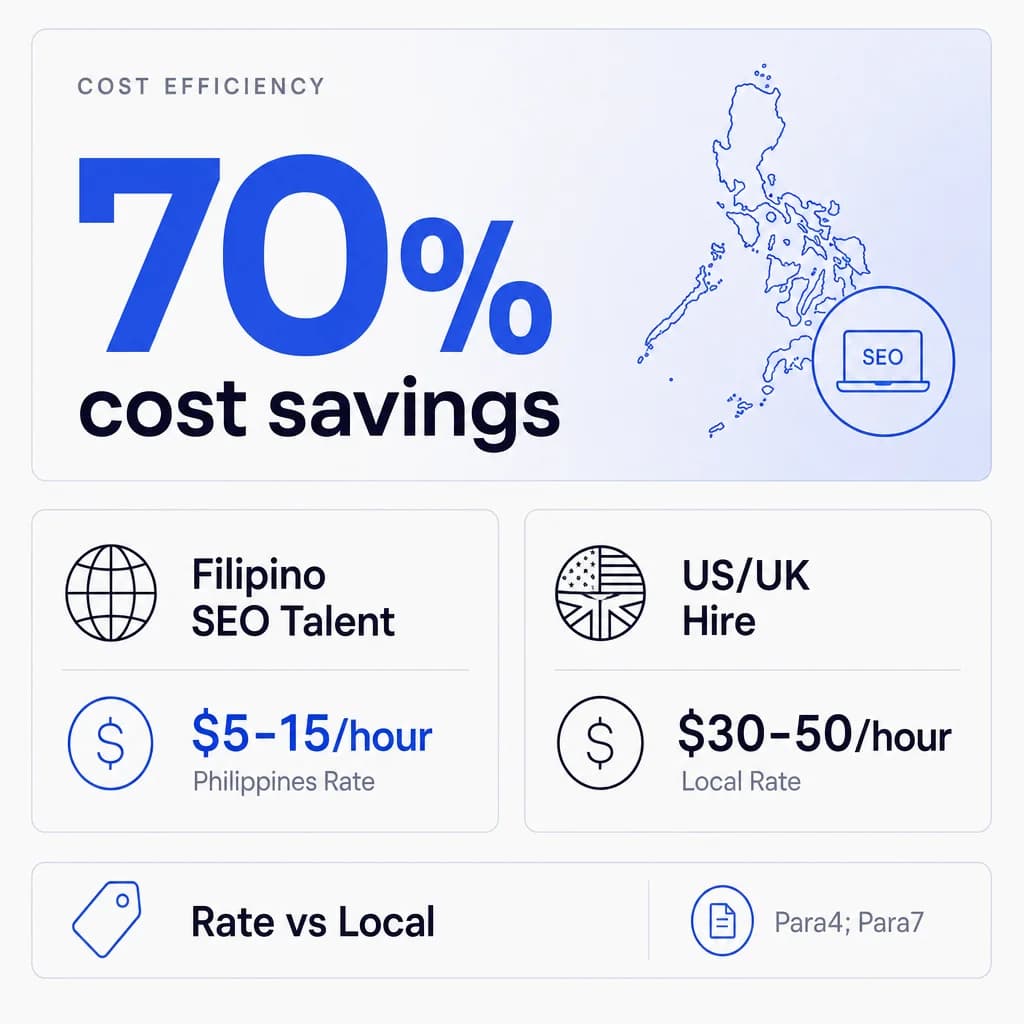
70% cost savings compared to US/UK hires. That’s not a typo.
VA Masters released data in April 2026 showing US firms make up 50% of Filipino remote worker hires. UK, Australia, and Canada combined? Another 28%.
One e-commerce owner put it simply: “Saved 75% on design costs.” A real estate business owner said their Filipino remote worker “transformed my business” handling admin and SEO tasks.
The rate? $5-15/hour for work that costs $30-50/hour locally in the US, UK, or Australia.
But here’s the thing nobody talks about.
How This Actually Works in Practice
Filipino remote workers integrate into your SEO workflow because everything’s cloud-based now.
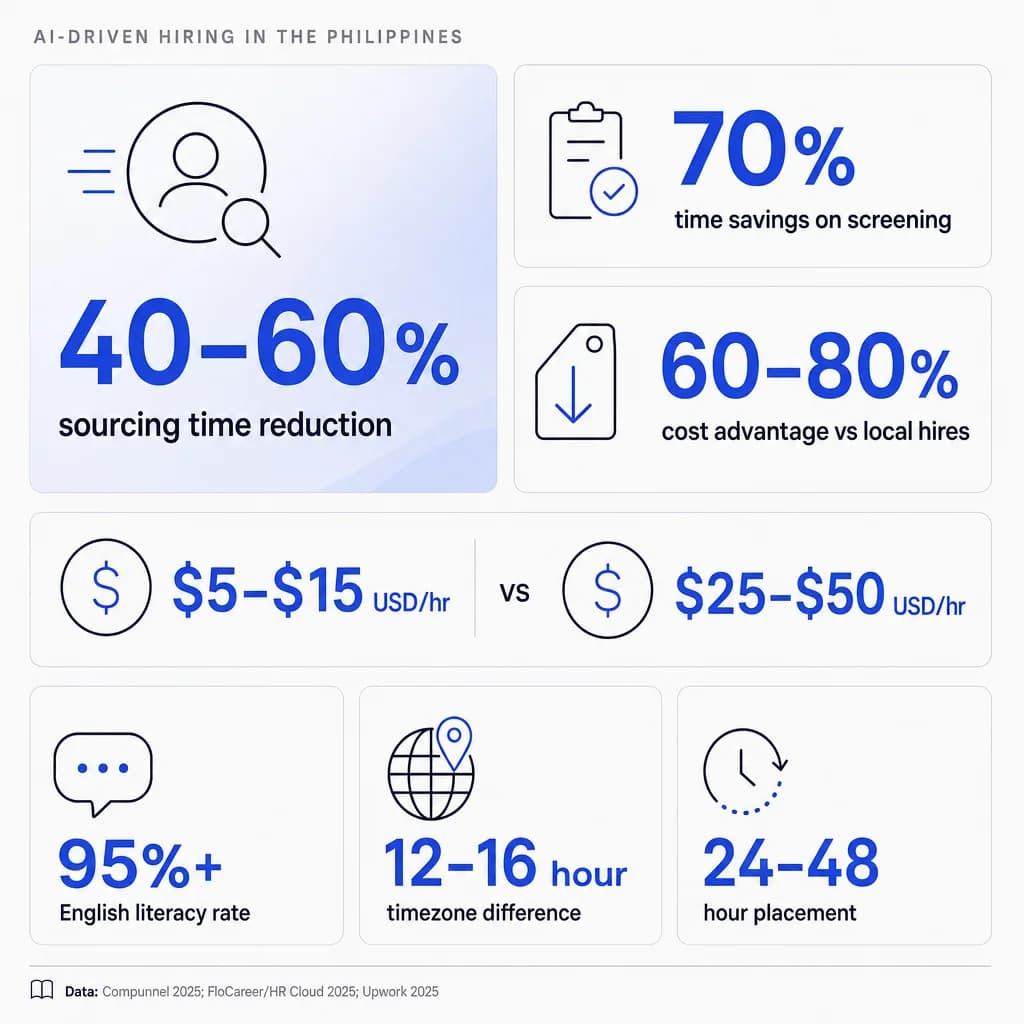
Ahrefs, SEMrush, Google Analytics — they access the same tools you do. Plus, English proficiency in the Philippines is over 90%.
Getting Started Takes Less Time Than You Think
Week one and two are onboarding.
Use Loom videos for your processes. One UK SEO lead said: “Shared screen recordings of my keyword process. My Filipino hire replicated it in 3 days.”
Your onboarding toolkit:
Notion for documentation
Slack for daily communication
Loom for process videos
Zoom for weekly check-ins
Hunt St tests candidates on real scenarios like SEO audits before hiring. You should too.
The Daily SEO Workflow Breakdown
Here’s what a Filipino SEO specialist actually does at $1,600/month ($10/hour) for 20 hours per week:
Keyword Research
They identify 50-100 terms monthly using Ahrefs and Google Keyword Planner. You get CSV reports with volume and competition data. One fashion e-commerce company said their hire “grasped our niche keywords fast.”
Expected output: Comprehensive keyword reports with search volume, competition metrics, and ranking opportunities.
On-Page Optimization
Auditing and fixing meta descriptions, H1 tags, and schema markup using Screaming Frog and Yoast. Expect 20-50 pages optimized monthly. Result? One company saw traffic up 30%.
Expected output: Monthly optimization reports showing pages improved and specific changes made.
Content Optimization
They brief writers and optimize drafts using SurferSEO and Grammarly. 10-20 posts ready for publishing each month. An agency noted “proactive improvements” they didn’t even request.
Expected output: Publication-ready content with proper keyword density, readability scores, and SEO structure.
Link Building
Outreach and guest posting using Hunter.io and BuzzSumo. 10-20 quality links monthly. A Toronto executive said it was “better than local at $8,000/month ($5,000 CAD).”
Expected output: Monthly link reports with domain authority, anchor text, and placement details.
Technical SEO
Site audits and speed fixes via Google PageSpeed and GTmetrix. Monthly reports with fixes already implemented. One tech leader said their hire “caught issues before escalation.”
Expected output: Technical audit reports with priority fixes and implementation status.
Reporting
Tracking rankings and traffic through Google Analytics and Data Studio. Weekly dashboards delivered. A real estate investor said it “freed me for strategy.”
Expected output: Visual dashboards showing traffic trends, ranking changes, and conversion metrics.
Scaling Your SEO Operations
Start with 10-20 hours per week. VA Masters shows UK and AU companies average 90-100 hours monthly. Scale to full-time once you see results.
Measuring Results and Growing Your Team
Track organic traffic. Most companies see 30-50% increases in 3-6 months.

Tools sync automatically. No manual data entry.
Want to scale? Add PPC to your SEO hire’s responsibilities. MagentIQ does this. Global Hola says “remote SEO boosts rankings, cuts overhead.”
How to Actually Hire Someone This Week
Step 1: Choose Your Platform
HireTalent.ph specializes in connecting you with pre-vetted Filipino remote workers and handles compliance and payments.
OnlineJobs.ph works for direct hires if you want full control.
Arc.dev focuses on tech SEO roles for more technical positions.
Step 2: Write a Clear Job Post
Example: “Senior SEO Specialist: Ahrefs/SEMrush experience required. US/UK/AU timezone. $1,600-$2,400/month ($10-15/hour), 20hrs/wk. Tasks: keyword research, on-page optimization, reporting.”
Don’t overcomplicate it. Be specific about tools, hours, and deliverables.
Step 3: Test Before Committing
Give a 48-hour test: “Audit my site, suggest 10 fixes.” Interview via Zoom.
Watch how they think. Tools knowledge matters less than problem-solving.
What to look for:
How they approach problems
Their communication clarity
Their understanding of your business context
Their ability to prioritize tasks
Step 4: Set Up Contracts and Payment
Direct hire means no middlemen taking cuts. Use Deel or Payoneer for payroll. Some managed services like Wishup charge $1,299 monthly but handle everything.
Payment best practices:
Start with weekly payments for the first month
Move to bi-weekly after trust is established
Use milestone-based bonuses for exceptional work
Step 5: Avoid the Common Mistakes
Skip the unvetted low-bidders on Upwork. Employers consistently report that dedicated platforms lead to 80% longer engagements than freelance marketplaces.
Red flags to watch for:
Candidates who can’t explain their process
No portfolio or case studies
Unwillingness to do a paid test
Communication delays during hiring
The Math That Makes This Obvious
$10/hour × 160 hours monthly = $1,600
Same role in the US = $8,000
That’s $6,400 in monthly savings. $76,800 annually.
The ROI Calculation
Add the traffic gains. Global Hola case studies show 5-10x return on investment.
One company making $50,000 monthly grew to $75,000 with a single SEO hire. That’s $25,000 in new revenue. Cost? $1,600 monthly.
Break-even analysis:
Month 1-2: Onboarding and setup
Month 3-4: Initial traffic gains (10-20%)
Month 5-6: Significant ranking improvements (30-50%)
Month 7+: Sustained growth and scaling
What You Should Do Next
Start with one hire. 20 hours per week. $1,600-$1,920/month ($10-12/hour).
Give them one clear project. Keyword research for your top 5 pages. Or audit your site’s technical SEO.
Measure results in 30 days.
Success metrics to track:
Keyword rankings for target terms
Organic traffic changes
Technical issues identified and fixed
Quality of deliverables
Communication responsiveness
If traffic increases, scale hours. If rankings improve, hire a second person.
The companies winning right now aren’t overthinking this. They’re testing, measuring, and scaling what works.
Filipino remote workers aren’t the future of SEO. They’re the present. The question isn’t whether to hire. It’s whether you’re willing to let your competitors get there first.