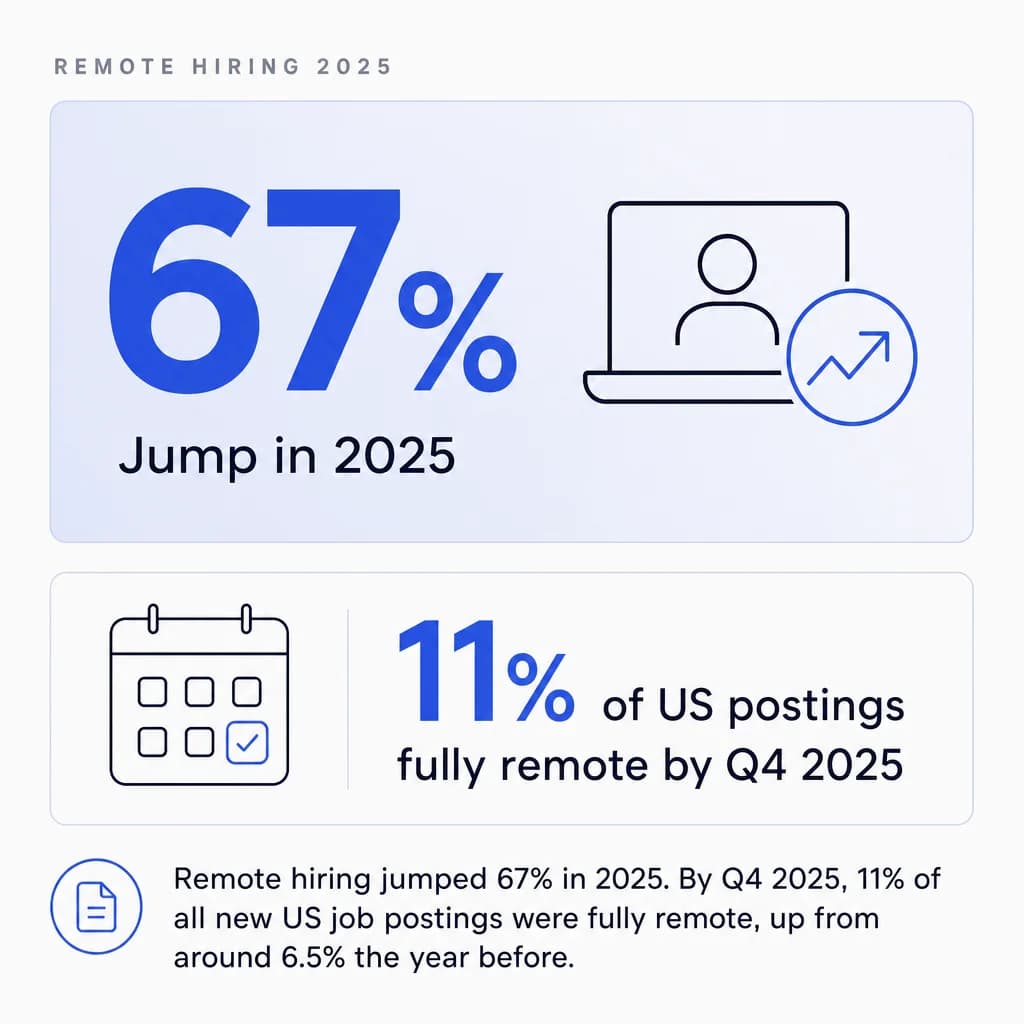
Remote hiring jumped 67% in 2025. That’s not a typo.

The data backs it up across multiple sources. Remote talent demand increased 29% year-over-year according to VAMasters.
By Q4 2025, 11% of all new US job postings were fully remote, up from around 6.5% the year before.
The global remote workforce hit 28%, up from 20% in 2020. In the US alone, that’s 35.1 million people working remotely as of August 2024.
Here’s what really matters: 70% of US, UK, and Australian business owners hired at least one remote worker in 2025. Nearly half of all enterprises with over 1,000 employees are using them now.
The World Economic Forum projects 90 million global digital remote jobs by 2030. This isn’t a trend. It’s the new baseline.
What Actually Drove the 2025 Remote Hiring Boom
Let me break down the real drivers behind this massive shift.
The Talent Shortage Reached a Breaking Point
US unemployment stayed steady, but finding skilled people for admin, customer support, and marketing roles became nearly impossible. Robert Half reported that 38% of professionals were actively job hunting in the first half of 2026.
Meanwhile, the Philippines has over 1.5 million BPO workers. English proficiency ranks #1 in Asia. The talent pool is massive and underutilized.
The Cost Savings Became Impossible to Ignore
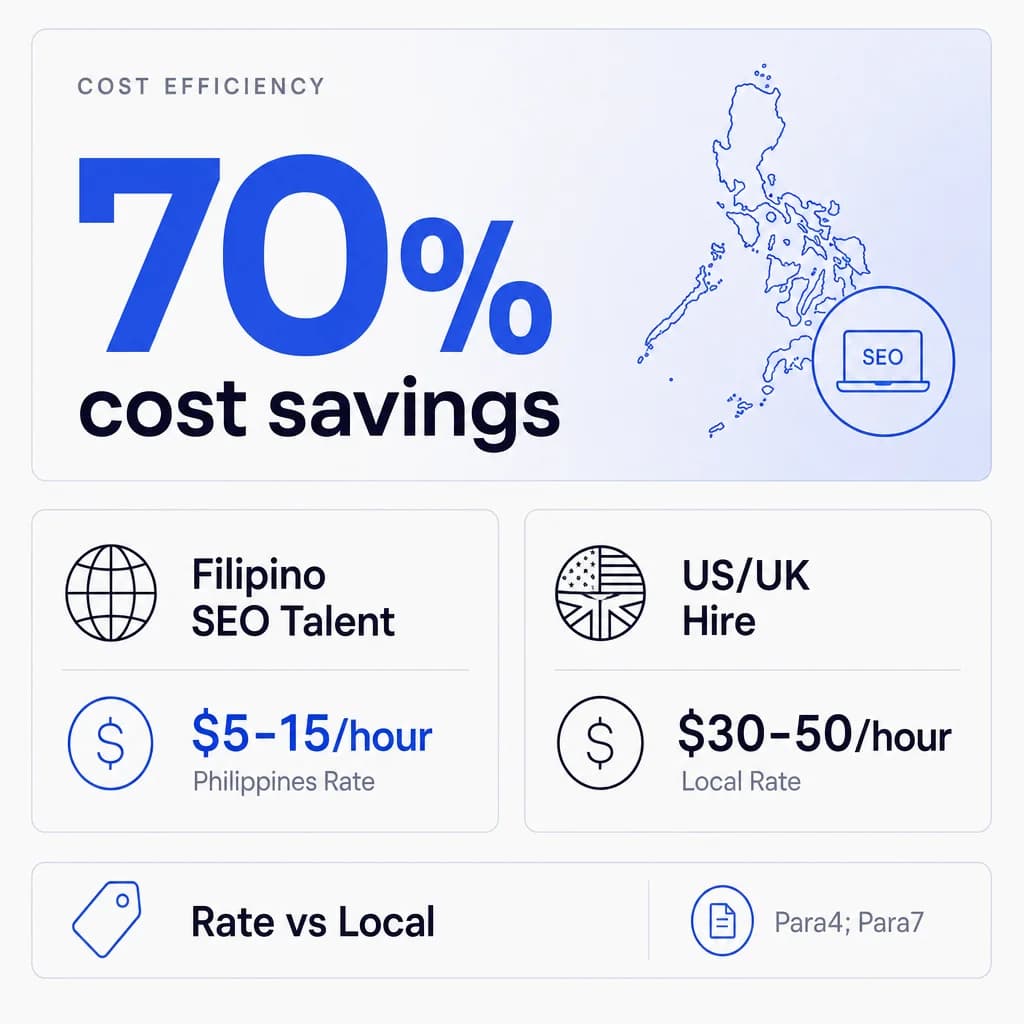
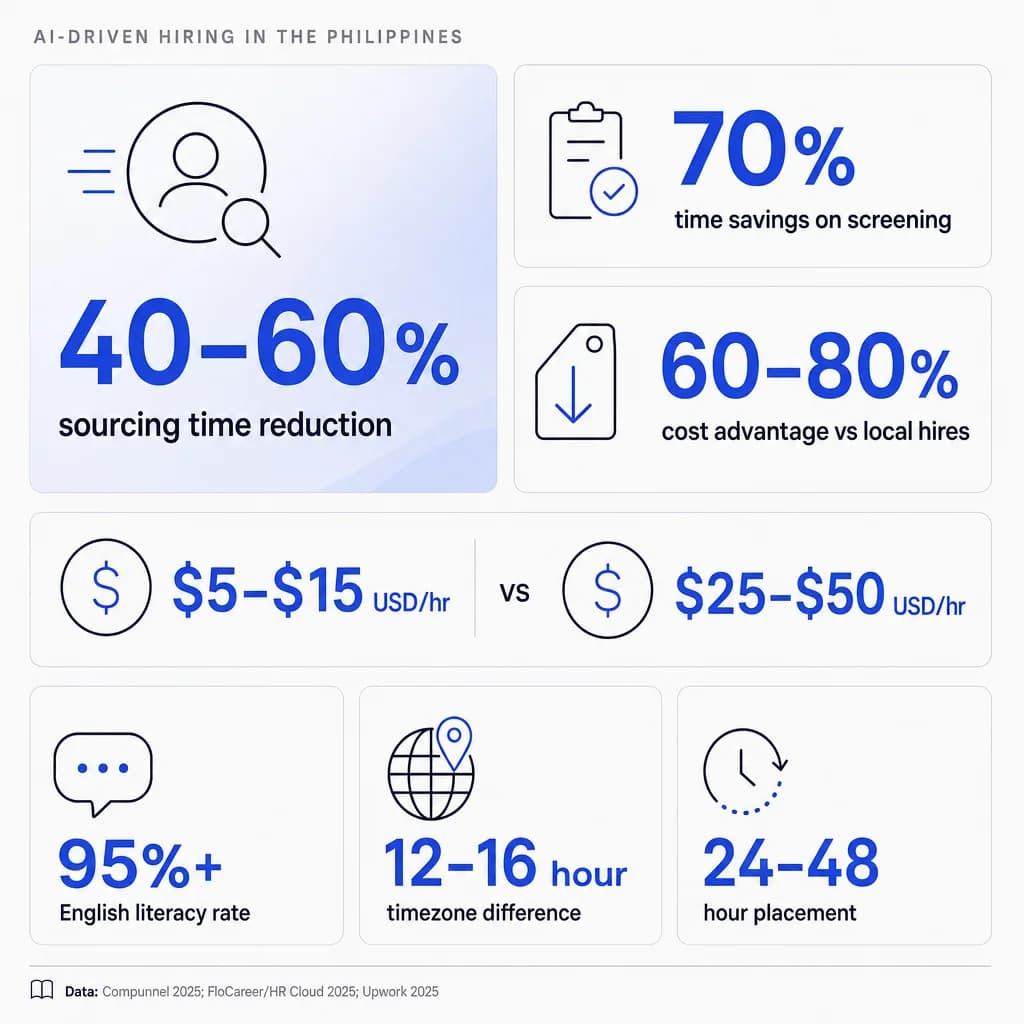
A remote worker in the Philippines costs $800–$1,600 per month for full-time work. Compare that to $4,000–$6,000+ for equivalent roles in the US, UK, or Australia.
One Australian business owner said he saved $50,000 in his first year by shifting 80% of his admin work to Filipino contractors.
The math isn’t just favorable—it’s transformative.
Hybrid Work Became the Permanent Standard
52% of the global workforce now works in some hybrid capacity. 70% of UK firms adopted hybrid models. 91% of employees prefer remote work options.
Companies realized they couldn’t demand full-time office presence and still attract talent. So they stopped trying.
The businesses that embraced this reality first gained a significant competitive advantage in hiring.
Technology Finally Caught Up to the Vision
AI tools, cloud platforms, and collaboration software made managing remote teams easier than managing local ones. 82% of CIOs accelerated their cloud adoption.
Video calls replaced hallway conversations. Async communication replaced meetings. It just worked.
The technical barriers that made remote work clunky in 2020 had essentially disappeared by 2025.
The Return-to-Office Push Failed Spectacularly
83% of CEOs planned return-to-office mandates. But actual remote work rates held steady at 22–23%.
Employees called the bluff. Companies that insisted on in-office work lost their best people. The ones that stayed flexible won the talent war.
This dynamic forced even resistant employers to reconsider their stance on remote hiring.
Why Filipino Remote Workers Became the Default Choice
Cultural Alignment That Actually Matters
Cultural fit matters more than people admit.
Filipinos grew up watching American TV, listening to Western music, and learning English in school.
They understand references, humor, and business etiquette without explanation.
Timezone Overlap That Works
The Philippines is 12–16 hours ahead of the US West Coast. That means some overlap with end-of-day US time and full overlap with Australian business hours.
UK businesses get afternoon/evening coverage. Australian companies get near-perfect alignment.
It’s not ideal for every situation, but it works far better than most employers expect.
The Skills Are Already There
66% of Filipino millennials report being more productive working remotely than in traditional offices. They know Excel, CRMs, Google Workspace, Slack, and whatever tool you’re using.
Many have years of experience working for Western companies through BPO centers. They’re not learning how to work remotely—they’re already experts.
Retention That Beats Local Hiring
81% of businesses increased their flexible hiring in 2025 because remote workers stayed longer than expected.
Offer fair pay and respect, and they’ll stick around. The turnover rates are often lower than comparable local positions.
A Market Growing at 23.4% Annually
The remote worker market has a 23.4% compound annual growth rate through 2035.
This isn’t a temporary arbitrage opportunity. It’s a fundamental restructuring of how global talent works.
The Risks Nobody Talks About (And How to Handle Them)
Security Concerns Are Real
41% of cyberattacks target remote work setups. Use LastPass or 1Password for credential management. Require two-factor authentication on everything.
Don’t give access to systems they don’t need. A customer support person doesn’t need access to your bank account.
Set up proper permissions from day one. It’s easier than fixing a breach later.
Timezone Differences Can Create Friction
If you need real-time collaboration every day, the Philippines might not work for US East Coast hours. Australia and the UK have better overlap.
Use async communication. Record video updates instead of requiring live meetings. Write detailed briefs instead of hopping on calls.
The companies that succeed with Filipino remote workers are the ones that build async-first workflows.
Some People Will Flake (Plan for It)
About 1 in 10 won’t work out. Budget for it. Interview twice as many people as you need.
The trial period exists for this reason. If someone ghosts after a week, you’re out $200, not $2,000.
This isn’t specific to remote workers it’s just hiring. But remote hiring makes it easier to recover quickly.
Loneliness and Isolation Affect Remote Workers
Younger remote workers especially struggle with this. Set up virtual coffee chats. Create a casual Slack channel for non-work conversation.
Check in on them as people, not just employees.
Remote workers who feel connected to the team stay longer and perform better.
What This Means for Your 2026 Hiring Strategy
The 67% growth in remote hiring isn’t going away.
Companies that figured this out in 2025 are now scaling. They’re hiring their second, third, and tenth remote worker. They’re building entire departments overseas.
The ones still trying to hire locally are paying double and settling for less qualified people.
Start With One Strategic Hire
Pick a role that’s clearly defined and doesn’t require constant in-person collaboration: customer support, data entry, social media management, or admin work.
Platforms like HireTalent.ph let you browse pre-screened candidates and start interviewing within a day, which removes the biggest friction point in remote hiring.
Track Everything That Matters
Measure output, not hours. If you’re paying $1,200/month and getting $4,000/month worth of work, you’ve won.
Set clear KPIs from the start: number of tickets handled, posts scheduled, entries completed—whatever makes sense for the role.
Data removes the guesswork and makes scaling decisions obvious.
Scale Gradually and Systematically
Once you’ve successfully managed one remote worker for three months, hire another. Then another.
Delegate the hiring process. Your first remote worker can help screen and train your second one. This is how you build a team without burning yourself out.
The businesses winning with remote hiring aren’t the ones who hired 10 people at once. They’re the ones who hired one, learned the system, then repeated it.
Final Thoughts
Remote hiring grew 67% because it works.
Companies are saving 60–78% on labor costs while reporting productivity gains of 13–42%. That’s not a tradeoff. That’s just better.
The Philippines offers the best combination of English proficiency, cultural alignment, cost savings, and available talent. That’s why 70% of US, UK, and Australian business owners hired at least one Filipino remote worker in 2025.
The question isn’t whether you should hire remotely. It’s whether you can afford not to.
Your competitors already figured this out. They’re hiring while you’re reading.
The data says remote work rates will stabilize around 22–27% of the workforce. Demand for remote workers will grow another 29% this year.
You can either be part of that growth or watch from the sidelines while your costs stay high and your talent pool stays shallow.
Start with one hire. See what happens.
Most people who do this never go back.