
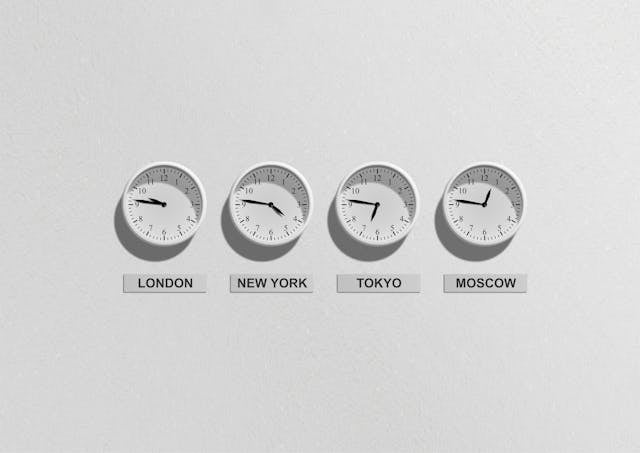
Brasília Standard Time (BRT) is UTC−3.
Philippine Time (PHT) is UTC+8.
That’s an 11-hour difference.
Philippines is always 11 hours ahead of Brazil.
When it’s 9:00 AM Monday morning in Brasília, it’s 8:00 PM Monday evening in Manila.
When it’s 3:00 PM in Brazil, it’s 2:00 AM the next day in the Philippines.
Here’s the thing that makes this easier than other time zone conversions: neither country uses daylight saving time.
The offset never changes.
It’s always 11 hours.
Every single day of the year.
Are You Looking to Hire in the Philippines and Unsure Where to Start?
Sign up for an account and recruit your next employee within minutes!
Complete Hour-by-Hour Conversion Table
Here’s every hour of the day converted from BRT to PHT.
Bookmark this page. You’ll come back to it.
| Brasília Time (BRT) | Philippine Time (PHT) |
| 12:00 AM (Midnight) | 11:00 AM |
| 1:00 AM | 12:00 PM (Noon) |
| 2:00 AM | 1:00 PM |
| 3:00 AM | 2:00 PM |
| 4:00 AM | 3:00 PM |
| 5:00 AM | 4:00 PM |
| 6:00 AM | 5:00 PM |
| 7:00 AM | 6:00 PM |
| 8:00 AM | 7:00 PM |
| 9:00 AM | 8:00 PM |
| 10:00 AM | 9:00 PM |
| 11:00 AM | 10:00 PM |
| 12:00 PM (Noon) | 11:00 PM |
| 1:00 PM | 12:00 AM (Midnight, next day) |
| 2:00 PM | 1:00 AM (next day) |
| 3:00 PM | 2:00 AM (next day) |
| 4:00 PM | 3:00 AM (next day) |
| 5:00 PM | 4:00 AM (next day) |
| 6:00 PM | 5:00 AM (next day) |
| 7:00 PM | 6:00 AM (next day) |
| 8:00 PM | 7:00 AM (next day) |
| 9:00 PM | 8:00 AM (next day) |
| 10:00 PM | 9:00 AM (next day) |
| 11:00 PM | 10:00 AM (next day) |
Look at that table closely.
When your workday starts in Brazil (9:00 AM), it’s already evening in the Philippines (8:00 PM).
When you’re having lunch in Brazil (12:00 PM), they’re getting ready for bed (11:00 PM).
When you’re wrapping up your day (5:00 PM), they’re just waking up (4:00 AM the next day).
What About Daylight Saving Time?
Here’s the good news, you don’t need a second table.
Brazil stopped observing daylight saving time in 2019.
The Philippines has never used daylight saving time.
So the 11-hour difference is permanent.
It’s always 11 hours, all year long.
This is actually one of the simplest international time zone conversions you can deal with.
The Overlap Window Challenge
You probably want some time where you’re both online at the same time.
For calls. For quick questions. For real-time collaboration.
With an 11-hour gap, you’ve got two realistic options:
Option 1: You start early
If you’re willing to start your day at 7:00 AM BRT, that’s 6:00 PM PHT.
Your Filipino worker is finishing their evening, but still reasonable hours.
You get a 2-3 hour overlap before they call it a night.
Option 2: They work late
If your worker is willing to stay online until 9:00 or 10:00 PM Philippine time, that catches you at 10:00 AM to 11:00 AM BRT.
Middle of your morning, end of their day.
Both options require someone to stretch.
That’s just the reality of an 11-hour difference.
Why Some Companies Keep Both Brazilian and Filipino Teams
I’ve seen this pattern a lot lately.
Companies hire South Americans (including Brazilians) for daytime coverage that overlaps with US business hours.
Then they hire Filipinos for overnight processing, Asian market coverage, or tasks that don’t require live interaction.
It’s a “follow the sun” setup.
When your Brazilian team clocks out, your Filipino team is just getting started.
Work keeps moving 24 hours a day.
The trick is making sure you’re not trying to force real-time collaboration across that 11-hour gap too often.
When It Actually Doesn’t Work
I’m not going to pretend every role works across an 11-hour gap.
If you’re running a real-time operation and it has to happen during Brazilian business hours, you need to hire for that explicitly.
Market it as a night shift position.
Pay it as a night shift position.
And understand that your candidate pool will be smaller because fewer people want to work those hours long-term.
But if your work is project-based, task-based, or deadline-based rather than time-based, the BRT to PHT conversion is just a scheduling detail.
Not a dealbreaker.
Final Thought
The 11-hour time difference between Brasília and the Philippines sounds like a huge obstacle.
It’s not.
It’s only an obstacle if you’re trying to force both sides into the same working hours.
Once you accept that asynchronous work is not just possible but often more productive, the time zone difference becomes irrelevant.
You get access to skilled Filipino remote workers.
They get access to international opportunities.
And the work gets done whether you’re both online at the same time or not.
Just be honest in your job posts about what you actually need.
Respect their local time even when you’re asking them to work outside it.
And stop doing manual time zone math—pick a tool and let it do the work for you.
That’s really all there is to it.
Ready to Find Your Next Great Hire?
Join our growing community of employers and start connecting with skilled candidates in the Philippines.