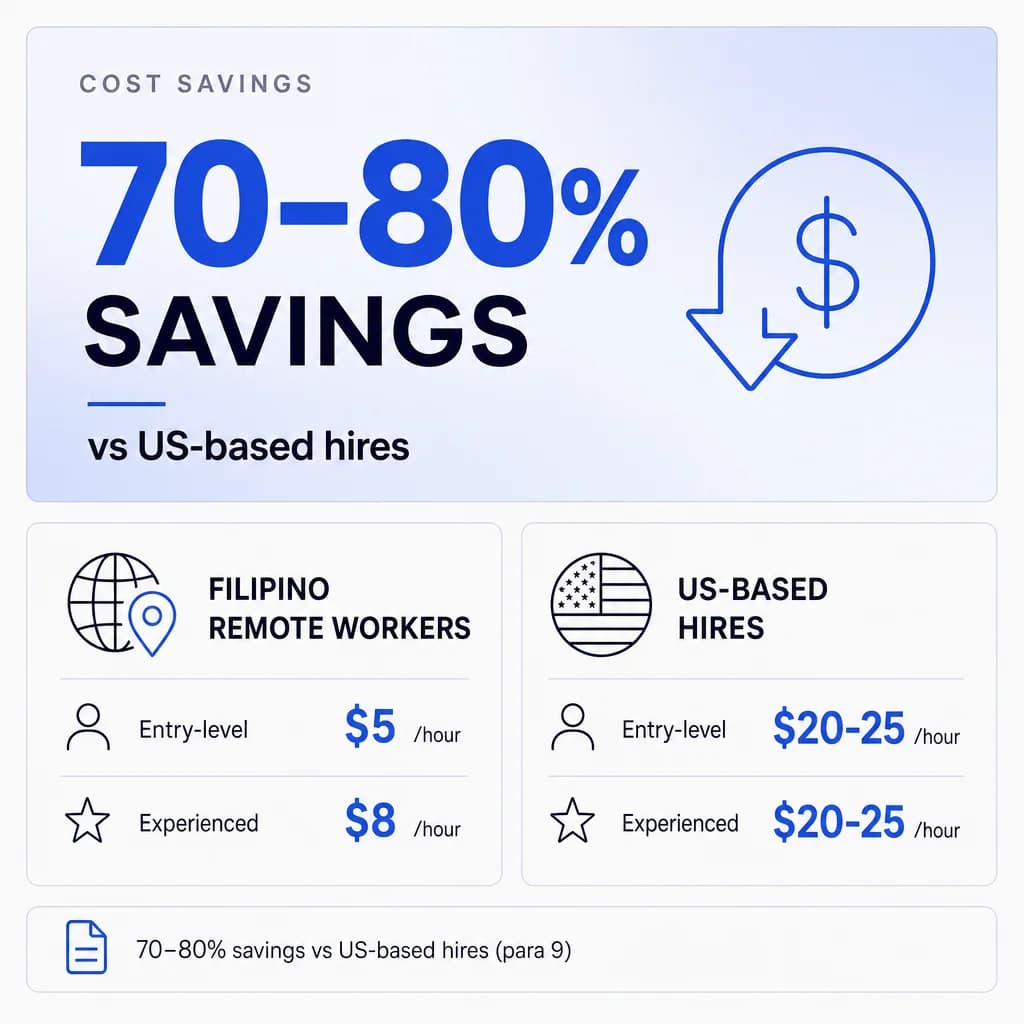
A medical billing specialist in the US costs around $40,000 to $50,000 annually. That’s roughly $20-25 per hour.
In the UK, you’re looking at £25,000 to £30,000 yearly. Australia? Similar numbers in AUD.
Filipino remote workers with HIPAA training and medical experience? They start at $5 per hour for entry-level roles. Experienced medical billing specialists with EHR expertise cap out around $10 per hour.
Let’s do the math on a full-time hire at $8/hour:
-
$1,280 per month
-
$15,360 per year
You’re saving 70-80% compared to hiring locally. And we’re not talking about cutting corners—these are skilled professionals handling patient scheduling, insurance verification, medical billing, and EHR data entry.

How HIPAA Compliance Works with Filipino Remote Workers
Here’s where people get nervous.
HIPAA violations carry fines from $100 to $50,000 per violation. In extreme cases, criminal charges. So yeah, you should be careful about who touches patient data.
But here’s what most people miss.
HIPAA Doesn’t Prohibit Offshore Workers
HIPAA requires proper safeguards regardless of where your team sits. The same security protocols you’d use for a US-based remote worker apply to Filipino remote workers.
The law focuses on how you protect data, not where your workers are located.
Filipino Remote Workers Understand HIPAA Requirements
Filipino remote workers trained for healthcare roles understand HIPAA requirements. They’re trained on Protected Health Information (PHI) handling, secure communication channels, and data access protocols.
Specialized training programs in the Philippines focus specifically on US healthcare compliance. Remote workers learn about:
-
Encryption standards
-
Secure file sharing protocols
-
Access logs and monitoring
-
Breach notification procedures
-
Minimum necessary standard
-
Patient rights under HIPAA
When you hire through platforms like HireTalent.ph, you can filter candidates by HIPAA training and healthcare experience, making it easier to find reviewed professionals who understand compliance requirements.
The platforms also handles basic security layers beyond basic compliance:
-
Non-disclosure agreements as standard practice
What These Remote Workers Actually Do
Let me break down the real tasks healthcare teams are delegating.
Patient Scheduling and Intake
Remote workers handle appointment bookings, patient registration, and intake forms. They manage cancellations, send reminders, and coordinate with multiple providers.
The phone skills matter here. Filipino remote workers consistently get high marks for their calm, professional phone manner. Patients don’t know or care that the person scheduling their appointment is in Cebu instead of California.
They handle:
-
New patient registration
-
Appointment confirmations and reminders
-
Cancellation management and rebooking
-
Waitlist coordination
-
Patient portal enrollment
-
Intake form completion
Insurance Verification and Authorization
This is tedious work that requires attention to detail. Verifying coverage, checking eligibility, obtaining prior authorizations, following up on pending claims.
It’s also work that doesn’t need to happen during US business hours. Your remote team verifies insurance overnight. Morning staff walks in with everything ready.
Typical tasks include:
-
Eligibility verification before appointments
-
Prior authorization requests
-
Benefits investigation
-
Out-of-network coverage checks
-
Coordination of benefits
-
Referral authorization tracking
Medical Billing and Coding
Filipino remote workers trained in medical billing handle claims submission, payment posting, denial management, and patient billing. Many are certified in ICD-10, CPT coding, and specific EHR systems.
Rates for experienced medical billers run $8-12 per hour. That’s for someone who knows Epic, Cerner, or Athenahealth inside and out.
Their responsibilities cover:
-
Claims submission and tracking
-
Payment posting and reconciliation
-
Denial management and appeals
-
Patient statement generation
-
Collection follow-up
-
Coding review and correction
EHR Data Entry and Management
Patient charts need updating. Lab results need uploading. Referral notes need filing. It’s necessary work that bogs down your clinical staff.
Remote workers handle data entry, chart preparation, and record maintenance. Your providers spend time with patients instead of clicking through EHR screens.
Common EHR tasks:
-
Chart preparation before appointments
-
Lab result uploading and filing
-
Prescription refill processing
-
Referral documentation
-
Progress note templates
-
Document scanning and indexing
The Cities Where Healthcare Talent Concentrates
Not all Filipino remote workers are equal. Location matters.
Cebu in particular has become a healthcare outsourcing hub. Multiple agencies train specifically for US medical practices. The talent pool is deep, and you’ll find workers with direct experience in American healthcare systems.
Manila offers the largest overall talent pool with exposure to international healthcare standards through multinational BPO operations.
Davao provides a growing market of well-trained professionals, often at slightly lower rates than Manila or Cebu.
What You Should Actually Pay
The rate ranges I mentioned earlier are real, but let me add context.
Entry-Level Medical Admin: $5-6/Hour
Monthly cost: $800-960 for full-time work
This gets you entry-level admin support. Someone who can handle scheduling, basic data entry, and patient communication. They’re trainable but need guidance and close supervision initially.
Best for:
-
Appointment scheduling
-
Patient reminders
-
Basic data entry
-
Email management
-
Simple insurance verification
Experienced Patient Coordinator: $7-8/Hour
Monthly cost: $1,120-1,280 for full-time work
This is the sweet spot for general medical admin work. You get someone with experience, solid English, and familiarity with healthcare workflows. They can work more independently and handle complex patient interactions.
Best for:
-
Complex scheduling coordination
-
Patient intake and registration
-
Insurance verification
-
Prior authorization requests
-
Patient communication management
Medical Biller with Certification: $9-11/Hour
Monthly cost: $1,440-1,760 for full-time work
This brings specialized skills. Medical billing certification, EHR expertise, experience with specific practice management systems like Kareo or AdvancedMD.
Best for:
-
Claims submission and tracking
-
Payment posting
-
Denial management
-
Coding review
-
Revenue cycle management
Senior Healthcare Specialist: $12-15/Hour
Monthly cost: $1,920-2,400 for full-time work
This is for senior-level remote workers with multiple years of US healthcare experience. They can work independently, manage other remote workers, and handle complex compliance issues.
Best for:
-
Team supervision
-
Process improvement
-
Complex billing issues
-
Compliance monitoring
-
Training and quality assurance
Even at the top end, you’re spending less than $30,000 annually for senior talent—a fraction of what you’d pay for equivalent expertise in the US, UK, or Australia.
How to Actually Hire Someone (Step by Step)
The hiring process is simpler than you think. Here’s exactly what to do.
Write a Specific Job Post
Be specific about what you need. “HIPAA-trained medical biller with Epic experience” works better than “healthcare virtual assistant.”
Include the tools they’ll use. If you run on Athenahealth and communicate via Slack, say that. You want candidates who already know these systems.
Specify:
-
Required EHR/practice management systems
-
Communication platforms
-
Expected working hours (in their time zone)
-
HIPAA training requirements
-
Specific certifications needed
Ask the Right Interview Questions
The interview matters more than the resume. Ask specific questions that reveal actual understanding:
-
“How do you handle protected health information in shared documents?”
-
“Describe your HIPAA training and certification.”
-
“What EHR systems have you used, and for how long?”
-
“How do you ensure data security when working remotely?”
-
“Walk me through how you’d process a denied insurance claim.”
-
“What would you do if you couldn’t verify a patient’s insurance before their appointment?”
Their answers tell you if they actually understand healthcare compliance or just listed it as a keyword.
Start with a Trial Period
A week or two of supervised work shows you how they handle real tasks. Can they navigate your EHR? Do they ask good questions? How’s their attention to detail?
Pay them fairly for this trial period, it’s real work. But keep the scope limited and supervision close.
Consider Starting Part-Time
Many practices start with contract work at $600-800 per month for part-time help. Once the remote worker proves themselves, convert to full-time.
This approach:
-
Reduces initial financial commitment
-
Allows you to test workflows
-
Gives you time to build trust
-
Lets you identify additional tasks to delegate
HireTalent.ph streamlines this process with built-in screening tools and compliance verification, letting you focus on finding the right fit rather than sorting through hundreds of applications.
The Skills That Actually Matter
When you’re reviewing candidates, certain skills separate good from great.
Technical Proficiency Beyond the Basics
They need to be comfortable with healthcare software, EHR systems, practice management platforms, billing software. Google Workspace and Microsoft Office are baseline requirements.
Look for specific platform experience. “5 years of medical billing” is vague. “3 years processing claims in Kareo with 98% first-pass acceptance rate” is concrete.
Ask about:
-
Specific EHR systems (Epic, Cerner, Athenahealth, eClinicalWorks)
-
Practice management platforms (Kareo, DrChrono, AdvancedMD)
-
Billing software experience
-
Familiarity with clearinghouses
-
Understanding of EDI transactions
Communication Clarity That Prevents Errors
Healthcare requires precise communication. Ambiguity causes problems. Your remote worker needs to write clear emails, document accurately, and ask clarifying questions when something’s unclear.
Phone skills matter if they’re handling patient-facing work. Have them do a mock patient call during the interview. Listen for:
-
Clarity and accent neutrality
-
Professional tone
-
Ability to explain complex information simply
-
Patience with confused or frustrated patients
-
Proper use of medical terminology
Process Orientation and Documentation
Healthcare is all about following protocols. Your remote worker should be comfortable with checklists, standard operating procedures, and workflow documentation.
Ask how they’ve handled process improvements in previous roles. Good candidates can describe systems they’ve implemented or inefficiencies they’ve fixed.
Look for someone who:
-
Asks for written procedures
-
Documents their own processes
-
Suggests improvements to workflows
-
Understands the importance of consistency
-
Can create training materials for future hires
Problem-Solving Within Boundaries
You want someone who can think independently but knows when to escalate. Healthcare has too many variables for pure script-following, but too much risk for cowboy decision-making.
Test this in interviews: “A patient calls saying their insurance was supposed to cover a procedure, but the claim denied. What do you do?”
Good answers include:
-
Reviewing the claim details for errors
-
Checking the patient’s current benefits
-
Looking for authorization requirements
-
Documenting the conversation
-
Escalating to a supervisor if needed
-
Following up with the patient on timeline
Security Measures That Actually Work
Let’s talk about protecting patient data with a remote team.
Implement Strict Access Controls
Your remote workers should only access what they need. If someone handles scheduling, they don’t need billing system access. Use role-based permissions in your EHR.
Implement unique logins for everyone. No shared accounts. Ever. You need audit trails showing who accessed what and when.
Best practices:
-
Role-based access control (RBAC)
-
Unique credentials for each worker
-
Regular access reviews
-
Immediate deactivation when workers leave
-
Monitoring of unusual access patterns
Use Only Secure Communication Channels
Email is not HIPAA compliant unless encrypted. Use secure messaging platforms designed for healthcare. Many practices use dedicated healthcare communication tools like TigerConnect or Updox.
For file sharing, use HIPAA-compliant services. Google Workspace and Microsoft 365 can be HIPAA compliant with proper Business Associate Agreements in place.
Never allow:
-
Personal email for work communication
-
Unencrypted file sharing
-
SMS for PHI transmission
-
Consumer-grade chat apps
-
Social media messaging for work
Secure All Devices and Connections
Require work to happen on secure devices. Many practices provide company laptops or use virtual desktop infrastructure (VDI) where remote workers access everything through a secure portal. Nothing stores locally.
Essential requirements:
-
VPN usage for all connections
-
Multi-factor authentication on all systems
-
Regular password changes
-
Encrypted hard drives
-
Automatic screen locks
-
Updated antivirus software
Maintain Proper Documentation and Training
Every remote worker should sign a Business Associate Agreement. This is a HIPAA requirement, not optional.
Provide regular compliance training. HIPAA rules update. New threats emerge. Annual refresher training keeps everyone current.
Document everything:
-
Who has access to what systems
-
What training they’ve completed
-
When they signed agreements
-
Incident reports and resolutions
-
Policy acknowledgments
-
Performance reviews related to compliance
If you ever face an audit, documentation saves you.
What Healthcare Teams Say About Making the Switch
I’ve talked to dozens of practice managers and healthcare administrators who’ve built Filipino remote teams.
The consistent theme? They wish they’d done it sooner.
A dental practice in Texas started with a single remote worker handling insurance verification. Within six months, they’d hired three more for scheduling, billing, and patient follow-up.
Their office staff went from drowning in admin work to focusing on patient experience.
The practice manager reported: “Our front desk staff actually smiles now. They’re not buried in phone calls and paperwork. They can greet patients, handle walk-ins, and make our office feel welcoming instead of chaotic.”
A telehealth company in Australia built their entire intake team in Manila. Twenty remote workers handling patient scheduling, insurance verification, and initial consultations.
They scaled faster than they could have with local hires, supporting a 300% growth in patient volume over 18 months.