Here’s something most people won’t tell you.
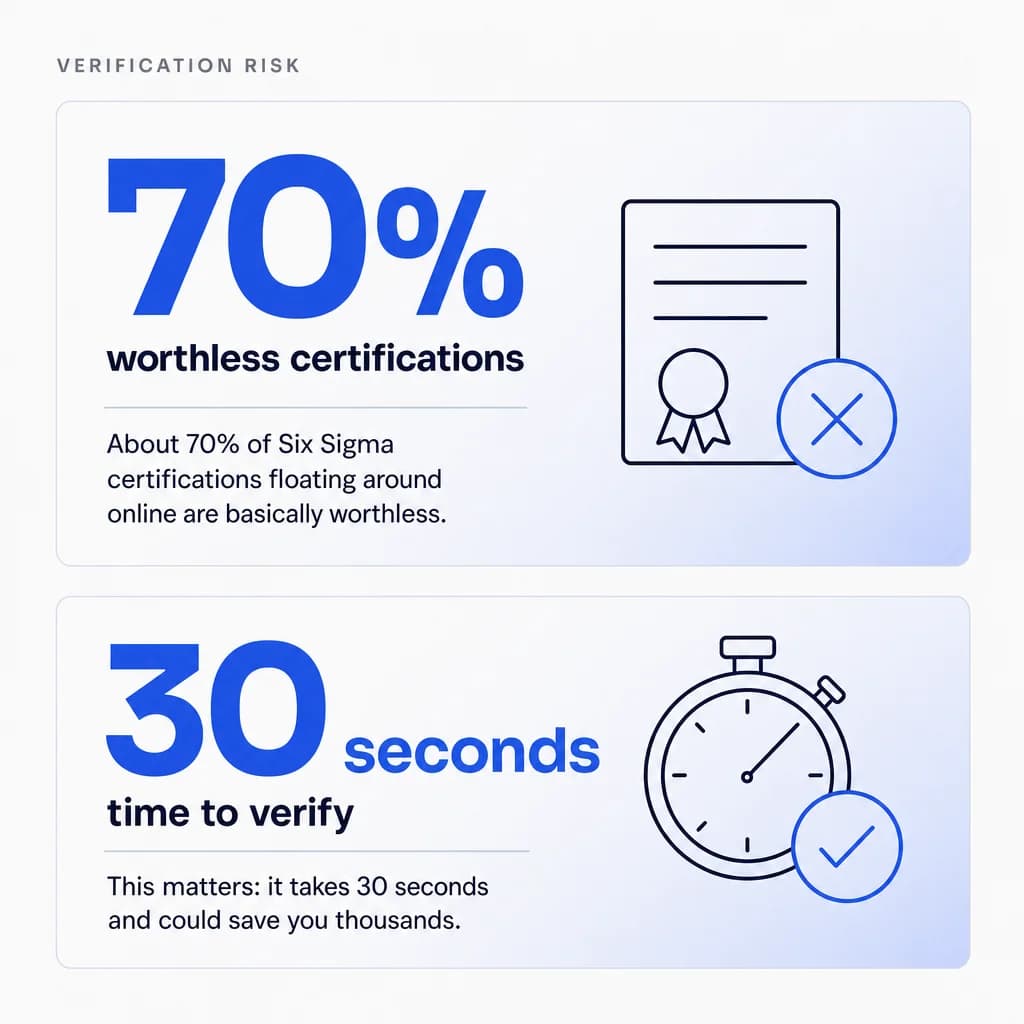
About 70% of Six Sigma certifications floating around online are basically worthless.
Not because the people are bad — because the certifications themselves come from providers that don’t actually verify anything.
I’ve seen business owners hire “certified” Six Sigma specialists who couldn’t explain what DMAIC stands for. They paid $15–20/hour for someone who took a weekend Udemy course and printed a PDF certificate.
That’s expensive incompetence.
So let’s fix that. Here’s how you actually verify if someone knows what they’re doing.
Are You Looking to Hire in the Philippines and Unsure Where to Start?
Sign up for an account and recruit your next employee within minutes!
Get StartedHow To Verify Six Sigma Certifications
Real Six Sigma certifications come from four main bodies: CSSC, IASSC, ILSSI, or ASQ.
Everything else is suspect.
The Philippines has tons of training providers offering “Six Sigma” courses. Some are legitimate. Most aren’t affiliated with any recognized body.
You need to know the difference before you hire.
Step 1: Demand the Exact Issuing Body in Writing
First thing: ask for the exact certification body in writing.
Not “I’m Six Sigma certified.” You need “I’m certified through IASSC” or “My Green Belt is from CSSC.”
If they can’t name the body, or they say something vague like “International Six Sigma Institute,” you’re done. Move on.
No recognized body means no way to verify. And if you can’t verify, you’re gambling with your money.
Step 2: Cross-Check Public Certification Registers
Legitimate certification bodies maintain searchable directories. Here’s where to look:
CSSC: sixsigmacouncil.org (shows accredited providers by location)
ILSSI: ilssi.org (lists training partners)
PeopleCert IASSC: iassc.org (searchable by accreditation number)
Here’s the trick: search using the exact legal entity name of the training provider.
Not “ABC Training PH.” You need “ABC Training Philippines Inc.” or whatever their registered business name is.
Why? Because scam providers use similar names to legitimate ones. Close doesn’t count.
Also check what belt levels they’re accredited for. A provider approved for Green Belt training can’t issue valid Black Belt certifications.
Step 3: Request the Candidate’s Unique Credential ID
Real certifications come with unique credential IDs or verification URLs.
Ask for it.
Bodies like IASSC and ILSSI let you look up individual candidates. If someone says they’re certified but can’t provide a credential ID, that’s a red flag the size of a billboard.
If they make excuses, walk away.
Step 4: Screenshot Everything with Today’s Date
Screenshot the register entries. Screenshot the candidate’s verification page. Add today’s date.
Save it all.
This matters if you ever need to prove due diligence, whether for audits or disputes. It takes 30 seconds and could save you thousands.
Step 5: Reject “Certificates” Without Actual Assessments
Some people think online certifications are automatically fake. That’s not true.
The format doesn’t matter. Online or in-person, both work.
What matters is whether there was an actual exam, project work, or assessment. If someone just watched videos and got a certificate, that’s not a certification. That’s a participation trophy.
Understanding Belt Levels and Their Red Flags
Not all Six Sigma belts are created equal.
White Belt and Yellow Belt: Entry-Level Credentials
These are entry-level. Often free or cheap. The CSSC White Belt exam takes 30–60 minutes.
Fine for someone supporting a Six Sigma project. Not enough for someone leading process improvement.
If you’re hiring for actual process optimization work, these belts aren’t sufficient on their own.
Green Belt: Where Real Expertise Begins
This is where it gets real. Requires knowledge of DMAIC methodology, statistics, and project work.
The CSSC Green Belt exam has 50 questions, takes 2 hours, and requires 60% to pass. It’s proctored online.
Look for candidates with 1–3 years of experience actually applying this stuff. They should be able to discuss statistical process control, root cause analysis, and design of experiments without hesitation.
Expect to pay $10–15/hour for qualified Green Belts from the Philippines.
Black Belt: Senior-Level Credentials
Serious credentials. Usually requires a bachelor’s degree plus 3 years leading projects or consulting.
Same exam format (50 questions, 60% pass, open book), but candidates should have a portfolio of major improvements.
If someone claims Black Belt certification but has never led a project that saved money or improved efficiency, they’re lying or confused.
Budget $20–30/hour for genuine Black Belts.
Universal Red Flags Across All Belt Levels
Watch for these warning signs:
No project portfolio showing real work
No named exam or proctored testing
“Lifetime access” courses with no assessment
Inability to name specific tools used (Minitab, SigmaXL, JMP)
Vague descriptions of past projects without numbers
What Matters More Than the Certificate
Certifications prove someone studied the material.
They don’t prove someone can actually do the work.
For remote workers handling process optimization for US, UK, or Australian companies, you need proof of applied impact. Consulting firms figured this out years ago. They care more about results than credentials.
Demand Real Project Examples Using DMAIC Framework
Request 2–3 case studies showing DMAIC or IDOV application.
You want specifics:
Define: What was the problem?
Measure: What data did they collect?
Analyze: What root causes did they find?
Improve: What changed? By how much?
Control: How did they sustain it?
Good answer: “Reduced call center errors by 30% for a 50-agent team in 3 months by implementing new quality checks and retraining protocols.”
Bad answer: “Improved processes” or “Responsible for quality initiatives.”
Vague language means vague results.
Screen Resumes Like Top Consulting Firms Do
Every bullet point should show one of these:
Problem Solving: Structured issue diagnosis. Look for words like “diagnosed” or “restructured.”
Quantitative Skills: Actual metrics. Percentages, dollar amounts, team sizes. “$50K saved, 15% faster cycle time.”
Leadership: Led teams or initiatives. “Managed 10-person remote team.”
Results: Measurable outcomes only. If they write “responsible for,” they probably didn’t actually do it.
No numbers = no hire.
Run a Paid Trial Task Before Committing
Give them a mini-project. Something like: “Analyze this dataset of customer support call logs using Excel or a free Minitab trial.”
You should get back value stream maps, root cause analysis (fishbone diagrams), and basic statistics like process capability indices or control charts.
If they can’t do this, the certification doesn’t matter.
Budget $100–200 for a 10–15 hour trial project. It’s cheap insurance against a bad hire.
Where to Actually Find Qualified Specialists
Most Six Sigma specialists from the Philippines work through a few platforms.
The quality varies wildly.
Specialized Platforms
HireTalent.ph focuses specifically on Filipino remote workers and includes verification tools that let you check credentials before you even interview.
This saves you the screenshot-and-verify dance. The platform pre-screens for legitimate certifications and English proficiency.
You pay slightly higher rates ($12–18/hour for Green Belts vs. $8–12/hour on general platforms), but the time savings and reduced risk usually justify it.
General Freelance Platforms
Upwork and OnlineJobs.ph have thousands of candidates. You’ll find people, but you’ll spend hours filtering.
Most require you to verify everything yourself using the steps above. Expect to review 20–30 profiles to find 2–3 worth interviewing.
You pay slightly higher rates ($12–18/hour for Green Belts vs. $8–12/hour on general platforms)
What to Look for During Interviews
Can’t explain DMAIC phases in plain English? Pass.
No experience with tools like Minitab, SigmaXL, or even Excel? Pass.
Certificate from a provider not listed in any official register? Hard pass.
Good signs:
Client references you can actually contact
LinkedIn profile that matches their resume
Portfolio with quantified results
Ability to discuss specific statistical methods used in past projects
Understanding Realistic Rate Expectations
Qualified Green Belts charge $10–20/hour. Black Belts run $20–30/hour.
If someone quotes $5–8/hour and claims Black Belt certification, something’s wrong. Either the certification is fake, or they lack the experience to command market rates.
Start with 10–20 hour contracts. Test the work before committing to anything bigger.
Many employers report that 70% of applicants don’t pass basic verification. That’s why the verification steps matter so much.

Additional Verification Steps
Contact References and Verify LinkedIn Profiles
Contact 2–3 past clients directly. Ask specific questions:
What project did they work on?
What were the measurable results?
Would you hire them again?
Verify LinkedIn endorsements match the portfolio. Anyone can endorse anyone on LinkedIn, but patterns matter. Do they have endorsements from actual clients or just random connections?
Look for recommendations that include specific project details and outcomes.
Test Tool Proficiency in Real-Time
They should know Minitab, JMP, or free alternatives at minimum.
Ask them to walk you through a simple statistical analysis. Screen share works fine for this.
Give them a small dataset and ask them to:
Create a control chart
Perform a basic capability analysis
Explain what the results mean in business terms
This takes 15 minutes and immediately separates people who know the tools from those who just read about them.
The Bottom Line
90% of unqualified applicants fail basic verification.
That’s actually good news. It means if you follow these steps, you filter out the noise fast.
Start with certification verification. Use the public registers. Get credential IDs. Screenshot everything.
Then move to proof of impact. Real projects with real numbers.
Finally, run a paid trial. Small investment, massive risk reduction.
The specialists who pass all three steps? They’re worth hiring.
The ones who don’t? You just saved yourself weeks of frustration and thousands of dollars.
Most business owners skip verification because it seems tedious. Then they spend months managing someone who can’t deliver.
Spend an hour verifying now, or spend months fixing problems later.
Your choice.