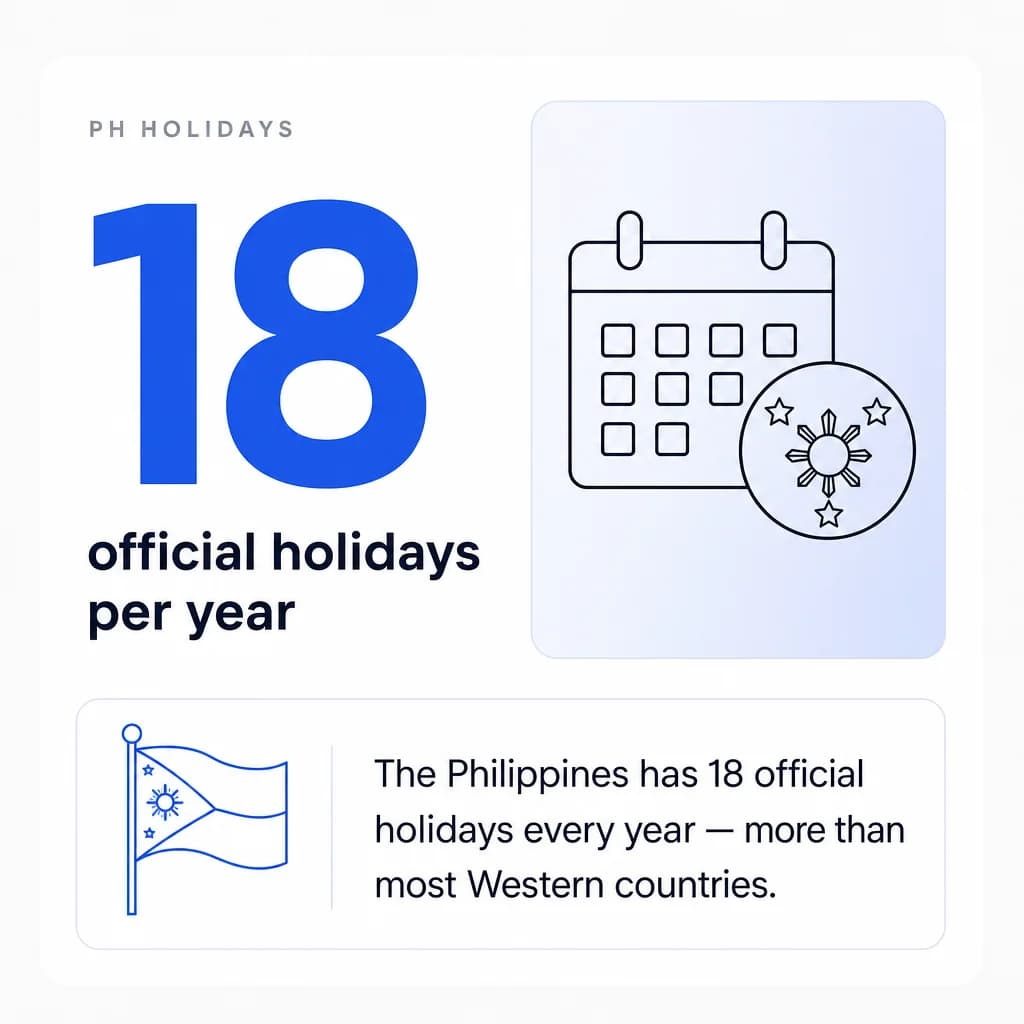
The Philippines has 18 official holidays every year more than most Western countries.
But here’s what really matters: regular holidays often mean complete shutdowns.
Special non-working holidays give workers the choice, but most still take them.
Employers commonly report 1–2 week slowdowns during peak periods.
Christmas is the biggest; Holy Week comes second. If you don’t plan for these, you’ll lose productivity when you can least afford it.

When Your Filipino Team Will Actually Be Offline
Below is the 2026 calendar based on Republic Act No. 9492 and Proclamation No. 368 s.2025.
Q1 Holidays: New Year and Revolution Day
-
January 1 (New Year’s Day) — Regular holiday. Expect low productivity from December 31 through January 2.
-
February 25 (EDSA Revolution Anniversary) — Regular holiday. Short impact, but still a full day off.
Q2 Holidays: Holy Week and Heroes
-
March 24–25 (Maundy Thursday & Good Friday) — Regular holidays. This is huge. Many Filipino workers extend this to a full week off (March 23–29). Family travel is common; you may not hear from them.
-
April 9 (Araw ng Kagitingan) — Regular holiday. Often bridges with Holy Week for an even longer break.
Q2–Q3 Holidays: Labor Day Through Summer
-
May 1 (Labor Day) — Regular holiday. Strong union presence means very low responses.
-
June 12 (Independence Day) — Regular holiday. A half-day of work is common the day before.
-
July (last Monday, Eid’l Adha) — Regular holiday. Date varies. Muslim areas are fully off, but nationwide impact is minimal.
-
August 25 (National Heroes Day) — Regular holiday. Long weekend.
Q4 Holidays: The Year-End Shutdown
-
November 1 (All Saints’ Day) — Special non-working. Many visit graves with family and also take November 2 off.
-
November 30 (Bonifacio Day) — Regular holiday. Marks the start of the holiday rush.
-
December 8 (Feast of the Immaculate Conception) — Special non-working. Pre-Christmas; often bridges to December 24–25.
-
December 24–25 (Christmas Eve & Day) — Regular holidays. The biggest blackout period. Expect 2–3 weeks of low productivity from mid-December through early January. Family comes first.
-
December 30 (Rizal Day) — Regular holiday. Caps the year-end shutdown.
-
December 31 (Last Day of the Year) — Special non-working. Ties into New Year celebrations.
The Bridge Day Factor
Watch for “bridge days.” If a holiday falls on a Thursday, many Filipinos take Friday off too. Proclamations can extend holidays throughout the year; monitor PNA.gov.ph or DOLE.gov.ph for updates.
What Actually Happens During These Holidays
The Christmas Blackout Reality
One Australian business owner lost a full month on a project. His Filipino team took two weeks off unpaid during Christmas; his freelance contractors still billed because the contracts required it.
A UK employer compared Holy Week to “US Thanksgiving times three.” Family comes first — that’s the culture.
The Christmas season (locally called pasko) starts in September. You’ll see decorations, hear music, and feel the energy shift. By December 15 productivity drops hard. By December 20 you’re often working alone until the first week of January.
Productivity Patterns You’ll Notice
-
One US entrepreneur said his Filipino worker was “2x faster outside holidays” but Labor Day and Independence Day meant “zero output.”
-
Manila workers tend to be more available year-round; provincial workers (Visayas, Mindanao) are more affected by family obligations.
How to Hire with Holidays in Mind
Ask the Right Interview Questions
Ask directly in interviews: “How do you handle Holy Week and Christmas availability?”
The best candidates will be upfront: they will say which specific days they take off or that they’re available with advance notice.
When vetting candidates on platforms like HireTalent.ph, filter for workers who specify holiday availability and time zone flexibility in their profiles. That saves surprises later.
Build Holiday Clauses Into Your Contracts
Include a clear holiday clause. Example: “Notify 2 weeks before holiday unavailability. No billing during full blackouts unless explicitly agreed.” Be explicit about expectations: fixed monthly pay vs. project-based billing. Don’t leave it vague.
The Timing of When You Hire Matters
Avoid November and December Starts
Don’t start new hires in November or December. Start mid-month when possible so you have runway before the next holiday.
Week One Onboarding Essentials
In the first week, share a six-month holiday calendar (a Google Calendar invite works well). Set up tools early: Slack or Asana with “Do Not Disturb” settings for Philippine holidays, and Google Workspace for shared documents.
Time Zones Will Mess with You
Understanding the UTC+8 Reality
The Philippines is UTC+8. That’s a 12–16 hour difference with the US East Coast depending on daylight saving time. If it’s 9 AM in New York, it’s 9 PM in Manila.
This requires an async-first communication approach. Don’t expect real-time responses unless pre-scheduled.
Finding Your Overlap Windows
US East Coast overlap is small: 9 PM–1 AM Manila time corresponds to 9 AM–1 PM ET. Asking someone to work evenings regularly isn’t sustainable.
Practical tip: use Loom videos for instructions. Many Filipino workers prefer watching a recorded walkthrough, executing the work, and then having you review.
Your Holiday Protocols Need to Be Automatic
Pre-Load Tasks Two Weeks Out
Two weeks before any major holiday, pre-load tasks and set auto-reply templates such as: “Out for [Holiday] Dec 24–Jan 2. Resuming Jan 3.” Batch November tasks so December can be slow; batch March tasks so Holy Week doesn’t derail momentum.
Build Cultural Rapport
Acknowledge holidays. Send a simple “Maligayang Pasko” (Merry Christmas) message in early December, or a small GCash gift or bonus. Small gestures significantly boost loyalty. One employer who sent a small beer-money gift saw retention improve dramatically.
How to Not Get Burned
Hire Redundancy Into Critical Roles
Hire two people for critical roles initially and cross-train them during low seasons (June–August). If one person goes offline during Holy Week, the other can cover.
Premium Pay Rarely Works
You can offer premium pay for holiday work (20% extra is common), but don’t expect many takers because family obligations are prioritized.
Start Small and Scale Smart
Start with one remote worker for admin tasks or social media management. After six months, add specialists. Budget $500–1,500 USD per month per full-time worker depending on skills. Platforms like HireTalent.ph can shorten hiring time by providing reviewed candidate profiles.
What Success Actually Looks Like
Real Employer Wins
-
A US owner who put the holiday calendar in Notion and blocked November/December for launches saw revenue triple.
-
An Australian agency stopped scheduling new projects during Holy Week and Christmas and used those periods for training, resulting in zero turnover for two years.
The Pattern That Works
Respect the holidays. Plan around them. Build systems that don’t require constant real-time contact. Filipino remote workers are reliable for about 11 months of the year if you work with their culture instead of against it.
What to Do Right Now
-
Download the 2026 holiday calendar and add it to your project management tool.
-
Hire your first Filipino worker through HireTalent.Ph, ask about holiday availability in the interview.
-
If you already have a team, send a six-month calendar and ask each person to confirm which holidays they will take.
The biggest mistake is assuming Filipino workers operate like Western employees.
The biggest win is planning for their holidays like you plan for your own vacation time.
Do that, and you’ll build a remote team that actually works.