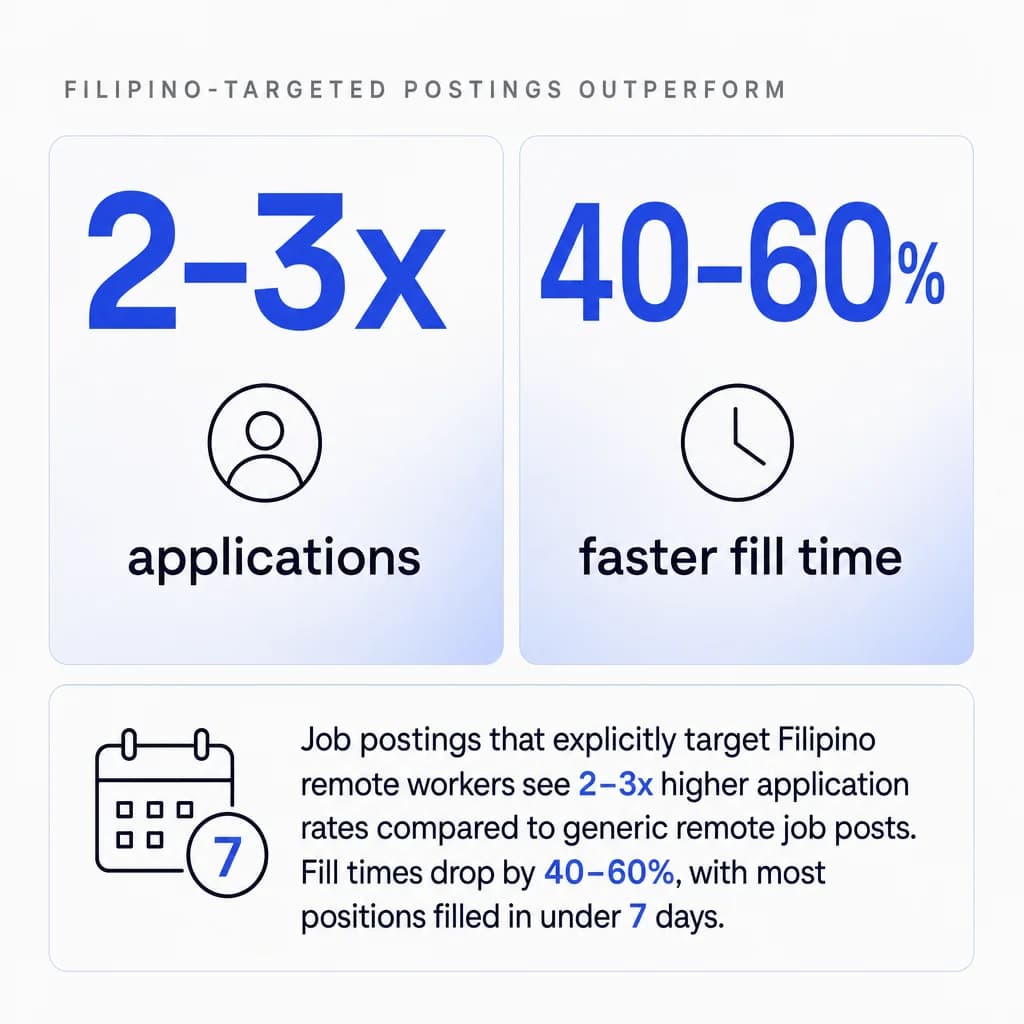
Job postings that explicitly target Filipino remote workers see 2–3x higher application rates compared to generic remote job posts.
Fill times drop by 40–60%, with most positions filled in under 7 days.
Data shows PH-targeted postings fill 60% faster averaging 4.7 days versus 12 days for global posts.
The Philippines has over 1.5 million people working as remote contractors and freelancers.
That’s a massive talent pool actively looking for opportunities with US, UK, and Australian companies.
When you target them directly, you’re fishing in a stocked pond instead of the ocean.
Are You Looking to Hire in the Philippines and Unsure Where to Start?
Get StartedWhy These Job Posts Rank Better on Hiring Platforms
Platform algorithms love specificity.
When you post “Filipino Customer Support Specialist” instead of just “Customer Support Specialist,” you’re competing with fewer listings. Way fewer.

SEO Tactics That Actually Work
Use location-specific keywords in your title. “Filipino Shopify Specialist” performs better than “E-commerce Specialist (Remote).” Google Keyword Planner shows 10,000+ monthly searches for terms like “hire Filipino freelancer” combined with specific roles.
Mention time zone compatibility. The Philippines is 12–16 hours ahead of US time zones, which means overlap for morning meetings or evening coverage.
Highlight English fluency. 95% of Filipino remote workers score B2+ on English proficiency tests—that’s near-native level.
Skip generic terms. Phrases like “remote worker needed” drown in a sea of 1 million+ global posts fighting for attention.
Filipino Talent Applies Faster and in Higher Volume
There’s an economic reality driving this.
A $6/hour job posting in the US gets ignored. In the Philippines, that’s competitive income—sometimes even above local market rates for skilled work.
The Numbers Behind the Speed
Filipino remote workers aren’t just interested. They’re motivated.
Unemployment in the Philippines sits at 5.2%. Remote work with US companies offers stability and dollar-based income. When you post a well-written job targeting Filipino talent, applications flood in.
Entry-level positions get 100–300 applications per week on OnlineJobs.ph. Even specialized roles like e-commerce management or bookkeeping pull 50+ qualified candidates.
Why Conversion Rates Are So High
Daily platform activity: Filipino remote workers are hunting for opportunities, not casually browsing.
High trial acceptance: 80% of employers offer paid trial periods (1–2 weeks). Filipino candidates accept these trials 90% of the time, compared to 60% acceptance globally.
Skills alignment: Top roles Filipino remote workers fill—admin support, social media management, e-commerce operations, bookkeeping, customer service—match exactly what US, UK, and Australian SMBs need.
If you’re hiring at scale or need to fill multiple positions quickly, platforms like HireTalent.ph streamline the process with reviewed candidate profiles and built-in compliance tools.
The Cost Advantage Is Real, But It’s Not the Whole Story
Yes, you save money. A lot of it.
Salary Ranges by Experience Level
Entry-level (admin, data entry): $3–5/hour ($500–800/month full-time)—70–80% less than US freelancers.
Intermediate specialists (social media, SEO, customer support): $6–10/hour ($1,000–1,600/month)—60–75% savings.
Expert-level talent (e-commerce managers, bookkeepers, project coordinators): $11–15+/hour ($1,800+/month)—50–65% savings compared to hiring locally.
Quality and Reliability Surprise Most Employers
But here’s what surprised me more than the cost: the quality and reliability.
Pepper VA’s 2026 report shows 90%+ client retention for Filipino remote workers. 85% of employer reviews specifically mention soft skills like adaptability, communication, and problem-solving.
How to Write a Job Post That Actually Converts
Most job posts fail because they’re vague or they bury the important details.
High-Converting Template
Title: “US Company Hiring Filipino Remote Worker for [Specific Role] – $[Rate]/hour”
Description:
“We’re a [type of company] based in [country] looking for a Filipino remote worker to join our team.
This is what you’ll do:
-
[Specific task 1]
-
[Specific task 2]
-
[Specific task 3]
What we need:
-
English fluency (written and spoken)
-
Experience with [specific tools/software]
-
hours per week availability
-
Comfortable with [time zone] overlap
What we offer:
-
$[X]/hour, paid [weekly/bi-weekly] via [PayPal/Wise/bank transfer]
-
Consistent hours
-
Long-term opportunity (we want someone who’ll grow with us)
To apply, send:
-
Your resume
-
Brief cover letter (3–4 sentences about why you’re a fit)
-
Links to previous work or portfolio
We’re specifically looking for Filipino talent because of the strong work ethic, English skills, and cultural fit we’ve experienced with past hires.”
Why This Format Works
This format works because it’s clear. You’re telling people exactly what you want and why you want them specifically.
Posts like this on OnlineJobs.ph get 150+ applications. Hiring happens within 4 days on average.
Where to Post for Maximum Visibility
Don’t just post in one place.
Top Platforms and Their Advantages
HireTalent.ph offers reviewed candidate profiles with skills assessments already completed, cutting your screening time significantly if you’re hiring multiple people.
OnlineJobs.ph is the obvious first choice. Over 1 million Filipino remote workers are active there. It’s built specifically for this market.
LinkedIn works if you use the right tags. “Philippines” in the location, “Filipino” in the job title, and relevant skills get you 300+ views and 40+ applications versus 10 with a generic post.
Screening Tips That Save Time
Add a typing test requirement (40+ WPM). This alone filters out 80% of unqualified applicants.
Ask for a 2-minute video introduction. You’ll immediately know their English level and communication style.
Give a small paid test task ($10–20). The people who complete it well are your serious candidates.
Do a 30-minute Zoom interview. Ask about their internet setup, backup power (brownouts are real in the Philippines), and work environment.
Protection Strategies
Start with a trial period. Two weeks at full rate. If it’s not working, you’re only out $200–300 instead of months of salary.
Use escrow for the first month if you’re on Upwork. 98% of transactions with Filipino talent go through without disputes.
Set clear KPIs from day one. “Respond to support tickets within 2 hours” or “Post 5 social media updates per day.” No ambiguity.
Check references. Actually call or message their previous clients. Filipino remote workers with good track records will happily provide these.
85% of Filipino remote workers stay with employers for over a year when expectations are clear and payment is consistent.
Why This Matters More Now Than Ever
Remote work isn’t slowing down.
More companies are realizing they don’t need to hire locally. The talent is global, and the Philippines offers the best combination of English fluency, cultural compatibility, cost savings, and work ethic.
When you target your job postings specifically at Filipino talent, you’re not just casting a wider net. You’re fishing where the fish are actually biting.
Your job posts rank higher because platforms reward specificity.
You get more applications because you’re speaking directly to a motivated, qualified audience.
You hire faster because the talent pool is actively looking for exactly what you’re offering.